
A Sociology of the Family Inquisitive Practice Test
$69.00
- Buy to unlock unlimited access to all Quiz questions.
- After purchase you can print a PDF of the whole quiz at any point. The PDF will contain the questions and the correct answers.
About this Exam
The Sociology of the Family Inquisitive Practice Test is a digital, mastery-based learning tool designed to prepare students for final assessments in undergraduate Sociology of the Family courses. This exam is not a standalone professional certification but an essential part of the curriculum offered through the Inquisitive platform, which is often integrated with a course’s primary textbook.
This study guide is designed for students enrolled in sociology, social work, family studies, psychology, and counseling programs who seek to deepen their understanding of the family as a foundational social institution. The practice exam helps students master complex concepts, theoretical frameworks, and research methods by providing iterative, adaptive questioning. It is an excellent resource for anyone aiming to excel in their academic course and develop a nuanced understanding of dynamic family structures.
Ready to test your knowledge?
Buy Now to Access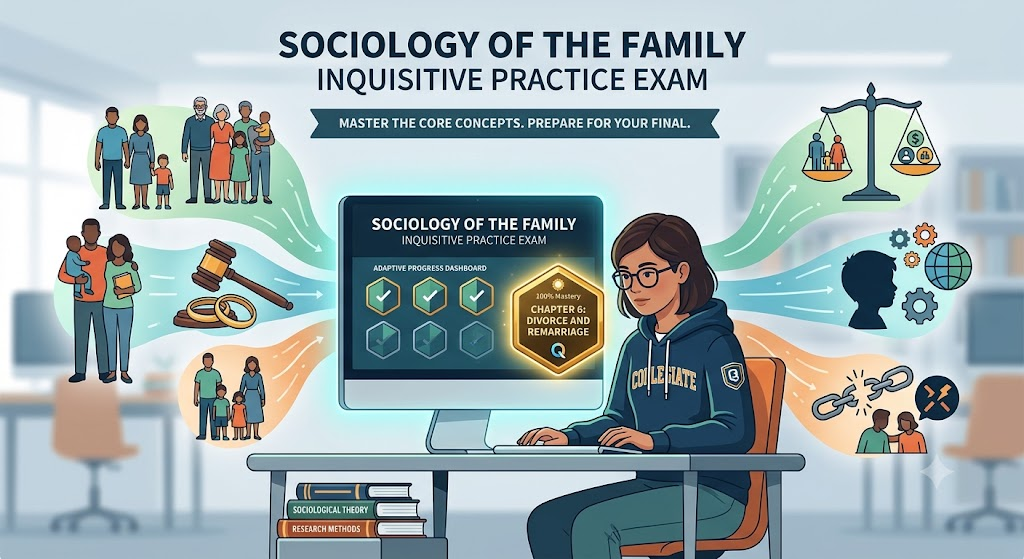
Additional Information
What the Course Entails and Exam Details
This comprehensive practice tool covers the entire syllabus of a standard Sociology of the Family course. The goal is to provide students with the ability to analyze the family unit through a critical, sociological lens.
Core Course Topics Include:
Theoretical Perspectives: Mastering functionalism, conflict theory, symbolic interactionism, feminist theory, and life course analysis as applied to family dynamics.
Defining the Family: Exploring the historical evolution, diverse definitions, and functions of the family (nuclear, extended, blended, single-parent, cohabiting).
Courtship and Marriage: Analyzing trends in dating, mate selection, homogamy versus heterogamy, and the changing meaning of marriage.
Parenthood and Childhood: Studying the social construction of childhood, parenting styles across social classes, and the impact of technology on family life.
Divorce and Remarriage: Understanding the structural causes, legal processes, and social consequences of family dissolution and reconstruction.
Family Issues and Crises: Critically examining topics such as family violence, poverty, work-family balance, and caregiving for the elderly.
Social Policy and the Family: Assessing how government policies on health, education, and social welfare affect different family forms.
What to Expect in the Final Exam
While the Inquisitive Practice Test is an interactive tool, it is specifically designed to prepare you for a formal, high-stakes final exam administered by your institution. You must use the practice modules to gain speed and conceptual clarity for the actual test.
Final Exam Format (Standard Academic Structure):
Format: The actual course final exam is typically a combination of Multiple Choice and True/False questions. It may also include a smaller section of Short Answer or Essay questions, requiring you to apply theoretical perspectives to contemporary issues.
Time Limit: You can expect a standard 90 to 120-minute window to complete the final exam.
Number of Questions: Final exams commonly consist of 70 to 100 multiple-choice and true/false questions.
Scoring: A passing score is determined by your specific university or instructor, but 70% (C grade) is often required to proceed in a major program.
Specific Rules: The final exam will be closed-book and may be proctored, either in person or through an online proctoring service.
How to Study and Exam Centers
Preparation for the Sociology of the Family final exam requires consistent engagement with the Inquisitive adaptive platform throughout the semester, not just a final cram session.
Actionable Study Strategies:
Engage in Iterative Mastery: Inquisitive is designed to be taken multiple times. Set a goal of reaching the 'mastery' level (indicated by a 100% or completion badge) for every assigned chapter module before the final exam.
Focus on 'Confidence' Ratings: The tool often asks you to rate your confidence in an answer. Pay close attention to questions where you were "Unsure" or "Wrong" even if you eventually got it correct. These are your knowledge gaps.
Cross-Reference with your Textbook: When you consistently struggle with an Inquisitive module, immediately review that section in the primary textbook. Look for the connections between the concepts being tested and the core theories presented.
Form Study Groups: Use Inquisitive performance reports to identify difficult concepts (like the difference between 'family of orientation' and 'family of procreation') and discuss them with classmates.
Exam Centers and Access:
Access: The Sociology of the Family Inquisitive Practice Test is accessed via an online portal provided by the course publisher. Students typically receive an access code with their textbook purchase or a course invitation from their instructor.
Final Exam Location: The formal final course exam is administered through your institution’s learning management system (LMS, e.g., Canvas, Blackboard) as an online portal, or it may be held in a physical classroom or designated testing center on your college campus. It is not taken through external testing providers like Pearson VUE.
Job Opportunities from the Course
A strong performance in Sociology of the Family and the associated degree program provides essential skills—such as analytical thinking, empathy, and systemic understanding—for careers focused on human behavior and social structures.
Specific Job Titles and Career Paths Include:
Family Support Specialist (Social services, nonprofit)
Social Worker Assistant (Requires further state licensure for full Social Worker role)
Child Advocate / Guardian ad Litem (Legal and social service settings)
Case Manager (Healthcare, housing, family support)
Human Resources Coordinator (Specializing in employee relations/benefits)
Public Policy Analyst (Nonprofit, government, focusing on family welfare)
Community Health Worker (Focusing on maternal/child health)
Family Life Educator (Developing curricula on parenting, relationships)
Probation Officer (Focused on youth and family intervention)
Frequently Asked Questions
Reviews
5.0
Based on 0 reviews
Leave a Review
No reviews yet. Be the first to review!