
A Level Sociology Education AQA Practice Exam
$69.00
- Buy to unlock unlimited access to all Quiz questions.
- After purchase you can print a PDF of the whole quiz at any point. The PDF will contain the questions and the correct answers.
About this Exam
The AQA A Level Sociology Education Practice Exam is an essential tool designed specifically for students preparing for the challenging AQA A Level Sociology qualification. This practice assessment focuses intensely on the 'Education' topic, which is a core component of the specification, particularly relevant to Paper 1 (Education with Theory and Methods). This exam is designed to help students refine their knowledge of sociological theories regarding education, master the unique application of research methods in an educational context, and perfect the high-level essay writing skills demanded by AQA examiners.
Ready to test your knowledge?
Buy Now to Access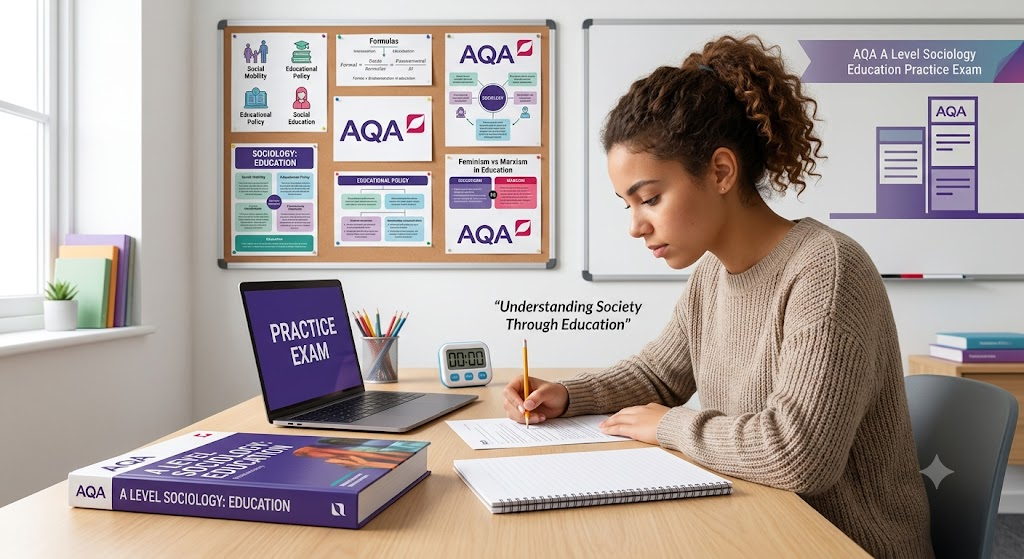
Additional Information
What the Course Ent entails and Exam Details
This examination covers the complete 'Education' module of the AQA A Level Sociology syllabus. The core topics tested include the role and purpose of education in society (functionalist, Marxist, feminist, and New Right perspectives); differential educational achievement by social class, gender, and ethnicity; internal and external factors affecting pupil performance; processes within schools (labeling, subcultures); and the relationship between education and social policy. Crucially, it also integrates the specific AQA assessment requirement of 'Methods in Context,' challenging students to apply their understanding of research methods specifically to investigations within educational settings.
What to Expect in the Final Exam
While this is a practice exam, it is structured to mirror the exact format, rigour, and time constraints of the official AQA A Level Sociology Paper 1, focusing on the Education section and its associated Methods in Context requirement. A typical practice exam will comprise approximately 50 marks, structured around different question types including short-answer, outline, and substantial extended essay questions. Students should expect to spend roughly one hour on the Education section, requiring efficient time management. The questions will assess students across three Assessment Objectives: AO1 (Knowledge and Understanding), AO2 (Application), and AO3 (Analysis and Evaluation).
How to Study and Exam Centers
Effective preparation requires a multi-pronged approach that moves beyond simple recall. Study strategies should include active revision methods such as creating concept maps, using flashcards for key studies and sociologists, and 'blurting' (rapid, non-stop writing) to recall key theories. However, the most critical strategy is practicing past paper questions under timed conditions and, most importantly, rigorously checking your answers against official AQA mark schemes. For the final, official AQA A Level qualifications, exams are not taken online but are sat at registered and authorized centers across the UK, which are primarily schools, sixth form colleges, and dedicated adult education centers. Students must ensure they are registered with an official center.
Job Opportunities from the Course
A qualification in A Level Sociology, with its focus on the intricate relationship between education and society, develops transferable analytical and critical thinking skills that are highly valued in numerous career paths. This certification can provide a crucial foundation or competitive advantage for roles such as:
Teacher (Primary or Secondary Education, specializing in Sociology, Social Studies, or related fields)
Educational Administrator
Special Educational Needs (SEN) Coordinator/Support
University Lecturer or Academic Researcher (in Education/Sociology)
Social Worker
Policy Analyst (in government departments or educational think-tanks)
Youth Worker
Journalist/Education Correspondent
Charity Project Manager (focused on educational equity)
Frequently Asked Questions
Reviews
5.0
Based on 0 reviews
Leave a Review
No reviews yet. Be the first to review!