
A-100 Basic Aviation Safety Practice Test
$69.00
- Buy to unlock unlimited access to all Quiz questions.
- After purchase you can print a PDF of the whole quiz at any point. The PDF will contain the questions and the correct answers.
About this Exam
The A-100 Basic Aviation Safety certification is a foundational program designed to equip individuals with the critical, universally applicable knowledge required to operate safely within the aviation environment. It is the essential first step for anyone aiming to build a robust understanding of aviation safety protocols, regulations, and risk mitigation strategies. This certification is ideal for new entrants across all aviation sectors, including flight operations, ground handling, cabin safety, and maintenance, as well as aviation enthusiasts and students looking for a comprehensive introduction to the field. It establishes a standardized safety language and serves as a prerequisite for many advanced aviation training programs.
Ready to test your knowledge?
Buy Now to Access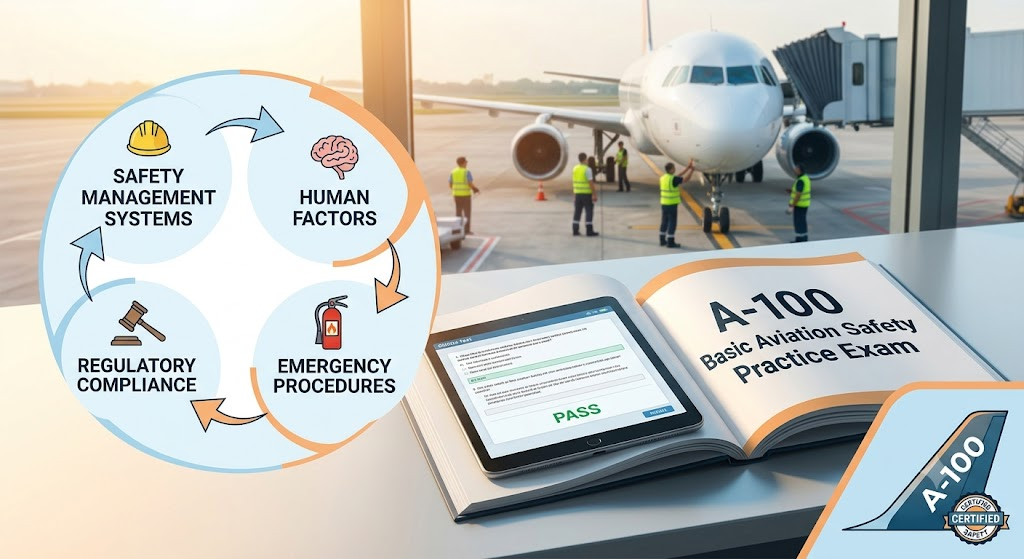
Additional Information
What the Course Entails and Exam Details
The A-100 course and its subsequent exam provide a comprehensive overview of fundamental aviation safety, focusing on the prevention of accidents and incidents through procedural knowledge and a strong safety culture. The core topics, syllabus, and skills covered include:
Safety Management Systems (SMS): An introduction to the four pillars of SMS—Safety Policy, Safety Risk Management, Safety Assurance, and Safety Promotion—and their role in creating a proactive safety environment.
Human Factors in Aviation: Understanding how human physiological and psychological capabilities and limitations affect safety, including decision-making, communication (CRM), fatigue management, and error analysis.
Regulatory Compliance: A thorough review of international and national aviation regulations, standard operating procedures (SOPs), and the role of oversight bodies like the FAA or EASA.
Emergency Procedures and Responses: Theoretical knowledge of emergency protocols for various scenarios, such as fire, depressurization, bird strikes, and passenger evacuation.
Airport Ground Safety: Protocols for safe movement on the ramp, runway incursion prevention, high-visibility clothing requirements, and ground support equipment (GSE) operation safety.
Aircraft Operations and Systems: A basic overview of how key aircraft systems (e.g., flight controls, engines, hydraulics) function from a safety perspective, including the importance of pre-flight checks.
Hazard Identification and Risk Assessment: Methods for identifying potential safety hazards and applying risk management processes to minimize them.
What to Expect in the Final Exam
The A-100 Basic Aviation Safety exam is a theoretical test designed to validate your comprehension of the course material. It does not typically involve a practical hands-on component at this level. You should be prepared for the following exam format:
Format: The exam is composed primarily of multiple-choice questions with four possible answers, requiring the selection of the single best option.
Number of Questions: The final exam typically contains between 50 and 75 questions.
Time Limit: Candidates are usually allocated a time limit of 60 to 90 minutes to complete the exam.
Passing Score: A minimum score of 70% or higher is required to pass, although some authorities or institutions may set a higher threshold.
Specific Rules: The exam is often closed-book. Electronic devices are generally prohibited, and calculations, if required, are basic and might require a simple non-programmable calculator provided by the test center.
How to Study and Exam Centers
Preparation is paramount for success in the A-100 Basic Aviation Safety exam. We recommend a multi-faceted study approach:
Actionable Study Strategies
Deep Dive into Official Materials: Thoroughly study the official A-100 Basic Aviation Safety manual and course workbooks. This is your primary resource.
Utilize Practice Exams: Regularly take realistic A-100 practice tests, such as the one in this guide or provided by your training center. These will familiarize you with the question style, time constraints, and help identify weak areas. Analyze both your correct and incorrect answers.
Create Custom Flashcards: Build digital or physical flashcards for complex regulatory codes, emergency procedure acronyms (e.g., PASS, CHECK), and core SMS definitions.
Join a Study Group: Collaborate with peers. Discussing human factors case studies or risk assessment scenarios can significantly enhance your practical understanding.
Focus on Weak Areas: Dedicate specific study blocks to the topics you find most challenging.
Where and How to Take the Exam
The A-100 exam is administered through several channels, depending on your affiliation and the awarding body.
Authorized Training Schools: Most aviation academies and specialized safety training organizations are authorized to conduct both the course and the final exam in-house. These physical centers provide a controlled testing environment.
Online Testing Portals: Some official awarding bodies offer the flexibility of proctored, online examinations. Candidates must meet specific technical requirements (e.g., webcam, secure browser, and a private room) and book a timeslot in advance.
Government and Interagency Testing Centers: For individuals aiming for certifications like those in the interagency aviation sector (e.g., USDA Forest Service, see search result 1.3.2), exams may be held at dedicated physical testing centers or authorized government offices.
Major Testing Networks: While less common for basic entry-level tests like the A-100, some related technical certifications use platforms such as Pearson VUE. However, you should check your specific course instructions first.
Job Opportunities from the Course
A-100 Basic Aviation Safety certification is a fundamental building block. While often not enough on its own for high-level specialized positions, it is a significant asset and often a mandatory requirement that unlocks access to numerous critical entry-level and developmental roles. Completing this course demonstrates a clear commitment to a safety-first mindset, making you a highly desirable candidate.
Career Paths this Certification Unlocks:
Cabin Crew Member (Flight Attendant)
Ramp Agent / Ground Handler
Aircraft Loader / Cargo Handler
Aviation Security Officer
Aviation Maintenance Technician (Apprentice/Trainee)
Flight Operations Officer / Dispatcher (Trainee)
Passenger Service Agent / Check-in Agent
Airport Safety Inspector (Entry-Level)
Aviation Safety Coordinator (General Aviation)
Ground Support Equipment (GSE) Operator
Drone Operator (Commercial Safety Module)
Frequently Asked Questions
Reviews
5.0
Based on 0 reviews
Leave a Review
No reviews yet. Be the first to review!