
911 Public Safety Telecommunicators (PST) State Practice Exam
$69.00
- Buy to unlock unlimited access to all Quiz questions.
- After purchase you can print a PDF of the whole quiz at any point. The PDF will contain the questions and the correct answers.
About this Exam
Embarking on a career as a 911 Public Safety Telecommunicator (PST) is a fulfilling and critical role in modern society. This certification is a significant step towards becoming the vital link between the public and emergency responders in high-stress situations. The 911 Public Safety Telecommunicators (PST) State Practice Exam is designed specifically for individuals aspiring to enter this field, as well as those already working but looking to validate their skills with a formal, recognized qualification at the state level. It serves as a comprehensive tool to assess and reinforce the knowledge and skills necessary for efficient emergency dispatch and telecommunications. This guide is tailored to help you understand the requirements and build your confidence for success.
Ready to test your knowledge?
Buy Now to Access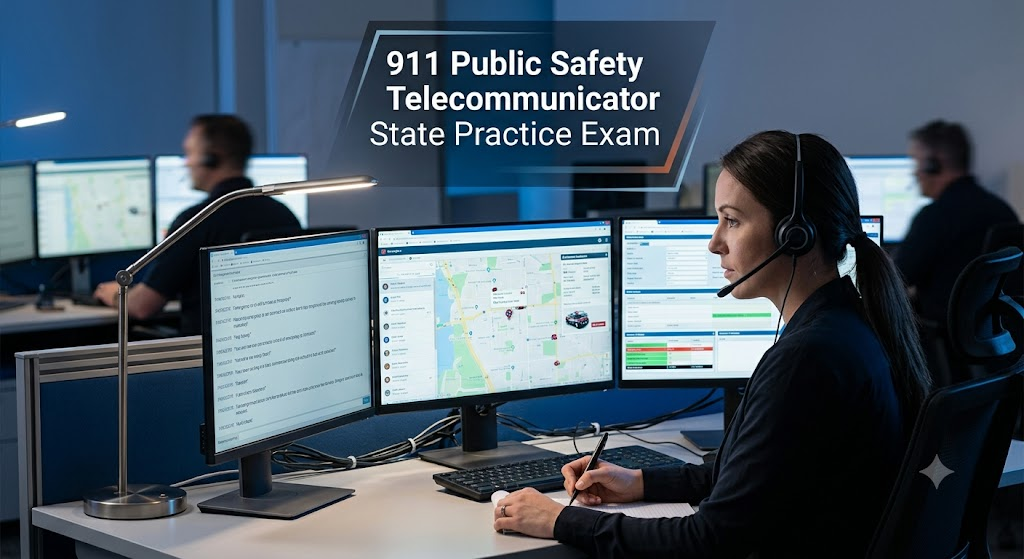
Additional Information
What the Course Entails and Exam Details
This practice exam covers the essential knowledge, skills, and scenarios that are fundamental to the daily responsibilities of a PST. It typically includes topics such as:
Emergency Response Protocols: Understanding the critical procedures and prioritization required in varying emergency situations.
Communication Techniques: Mastery of verbal communication, active listening, and clear instruction in critical moments.
Geography and Map Reading: Proficient understanding of geographic areas, navigation, and location finding under pressure.
Data Entry and Information Processing: Fast and accurate data entry, along with the ability to quickly process and relay vital information.
Legal and Ethical Considerations: Familiarity with privacy laws, departmental policies, and professional conduct in public safety.
Stress Management: Techniques for coping with the inherent high-stress nature of the job.
Familiarization with Equipment: Conceptual understanding of dispatch consoles, radio systems, and computer systems (though practical skills are usually evaluated separately or on-the-job).
The "State Practice Exam" is often curated to align with common state-mandated certification criteria, simulating the breadth and style of questions and scenarios you will encounter in the formal exam. It's not just about memorization but about applying logic and quick thinking to simulated, time-sensitive situations.
What to Expect in the Final Exam
While exact details can vary slightly depending on your specific state and certifying body, you can generally expect the following format in the actual 911 PST State Exam:
Exam Format: The formal exam is primarily composed of multiple-choice questions. It might also include scenario-based questions that require you to select the best course of action or process information under a simulated time limit.
Passing Score: A passing score is usually around 70% to 80% or higher. Your state or the specific certifying organization will dictate the exact requirement.
Time Limits: A final exam often has a strict time limit, reflecting the urgency of real-world dispatch. For example, some states require completing 100 questions within 100 minutes, mimicking the need for rapid decision-making. The practice exam should also feature a timer to help you build this skill.
Practical Component (Often Separate): It's crucial to note that while the written/knowledge exam is comprehensive, a practical assessment of typing speed, accuracy, and console operation is typically conducted by the individual employing agencies or during a training program, rather than as a single-state-controlled written exam element. The practice test focuses on the knowledge and reasoning required.
Rules and Proctoring: Formal exams are generally proctored, meaning they are supervised to ensure fairness and adherence to rules. You may not be allowed to use personal notes, the internet, or calculators during the formal test. The rule for taking the exam may restrict you from taking it while actively working at a console.
How to Study and Exam Centers
Preparation is paramount for success in this demanding field. Here’s how you can effectively study for and take your state certification:
Structured Study Guide: Utilize comprehensive study guides provided by your state or the approved course provider. These are often aligned directly with the exam’s competencies.
Use Practice Exams: Take advantage of practice exams, such as the one described, as they are invaluable for identifying knowledge gaps and improving your speed under simulated exam conditions. Review incorrect answers thoroughly to understand the logic.
Focus on Key Competencies: Dedicate study time to each core area. Practice active listening, review geography, and familiarize yourself with the common terminology and protocols of emergency services.
Improve Typing and Data Entry Skills: While not in the state written exam, your success in the field will rely on your ability to type quickly and accurately, so prioritize this in your overall preparation. There are many online resources and practice tests available for general typing proficiency.
Enroll in State-Approved Training: Most states require completion of a minimum hour training course (e.g., 40-180 hours) from an authorized educational provider or public safety agency. These courses provide deep knowledge and the required foundation. Enrollment often must happen within a certain period of hire.
Taking the Exam:
State-mandated certification exams are typically administered by state boards, accredited colleges, or dedicated public safety training centers.
Authorized Schools & Centers: Your state’s regulating body (e.g., Department of Law Enforcement, 911 Board) will have a list of authorized locations, which can include community colleges, specific training facilities, or approved testing centers (like those sometimes facilitated by organizations like Pearson VUE, though this can vary significantly by state).
Online Portals: Many states and training providers use secure online examination portals that must be proctored in a controlled environment at these authorized centers. Some remote proctoring options may be emerging, but check your state's current rules. You generally cannot take the test on duty at a functional console.
Scheduling: Once you have completed your required training, you will typically schedule your exam through the authorized testing provider or your training academy. Be sure to understand any application deadlines and required documentation, and note that there may be a limited number of attempts allowed within a certain timeframe.
Job Opportunities from the Course
A state certification for 911 Public Safety Telecommunicators unlocks a vital and stable career path, offering opportunities in various emergency communication roles:
911 Call Taker
Police Dispatcher
Fire Dispatcher
Emergency Medical Services (EMS) Dispatcher
Public Safety Telecommunicator (Combined roles)
Communication Officer
Emergency Services Operator
Non-Emergency Call Taker (often within the same communication center)
Dispatch Supervisor / Lead Telecommunicator (with experience)
Emergency Communications Manager (career advancement)
Your certification demonstrates not only a solid foundation of essential skills and knowledge but also your commitment to public service and safety, making you a highly qualified candidate for agencies across your state and potentially beyond, in an industry with consistent demand. We wish you the very best on your path to becoming a certified 911 PST!
Frequently Asked Questions
Reviews
5.0
Based on 0 reviews
Leave a Review
No reviews yet. Be the first to review!