
911 Dispatcher Practice Test
$69.00
- Buy to unlock unlimited access to all Quiz questions.
- After purchase you can print a PDF of the whole quiz at any point. The PDF will contain the questions and the correct answers.
About this Exam
A 911 Dispatcher (Public Safety Telecommunicator) plays a critical role in emergency response, serving as the first line of communication between individuals in distress and essential services like police, fire, and medical help. This high-stakes profession requires unique skills, including intense multitasking, clear communication under pressure, rapid decision-making, and emotional resilience.
The [911 Dispatcher Practice Test] is an essential preparatory tool designed for aspiring public safety professionals. This practice test is not just about memorizing facts; it’s an immersive experience that simulates the real, fast-paced environment and types of assessments you will encounter during the official employment and certification process. Achieving certification proves you possess the essential cognitive abilities and temperament needed for this demanding but deeply rewarding career.
Ready to test your knowledge?
Buy Now to Access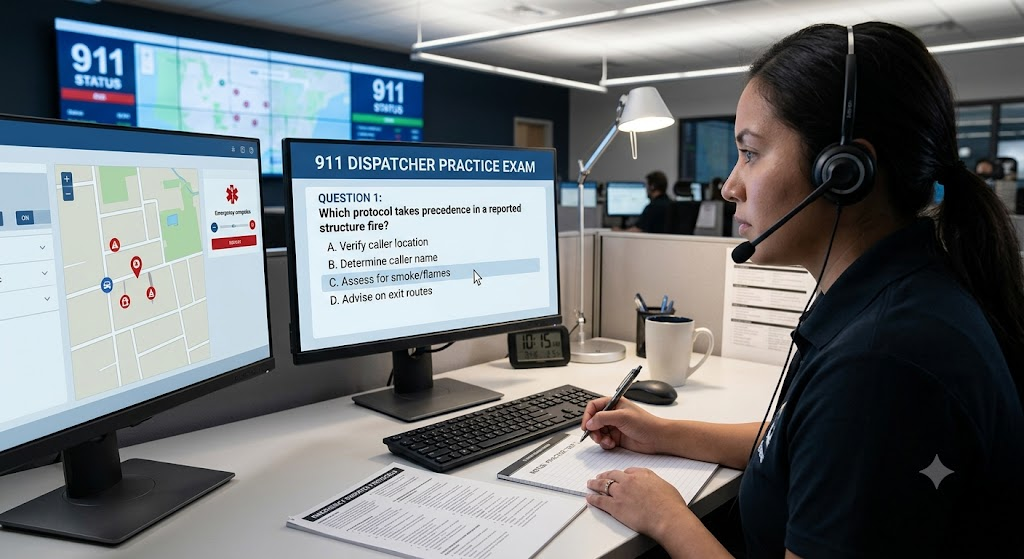
Additional Information
What the Course Entails and Exam Details
This practice guide focuses on the core competencies evaluated in official examinations across various jurisdictions. Preparing for the [911 Dispatcher Practice Exam] involves mastering several key skill areas:
Multitasking and Information Processing: Managing multiple inputs simultaneously, including listening to distress calls, entering data into Computer-Aided Dispatch (CAD) systems, and communicating with field units.
Emergency Protocols and Resource Allocation: Categorizing emergency vs. non-emergency calls and applying the correct protocols for dispatching police, fire, or medical services.
Listening Comprehension and Memory Retention: Accurately understanding critical details from callers in high-stress situations and retaining that information for immediate action.
Judgment and Decision Making: Evaluating complex scenarios rapidly and making life-saving decisions under time constraints and emotional pressure.
Map Reading and Spatial Navigation: Analyzing maps, identifying locations, and routing emergency vehicles efficiently using geospatial information.
Written Communication: Clear and accurate documentation of incident details for official records and court proceedings.
The specific syllabus of a course (which this practice exam prepares you for) varies by state and agency but generally covers emergency communication standards, agency procedures, and relevant laws, often following guidelines from organizations like APCO (Association of Public-Safety Communications Officials) or NENA (National Emergency Number Association).
What to Expect in the Final Exam
The formal examination process, which this [911 Dispatcher Practice Exam] simulates, is typically rigorous and multi-faceted. When taking the official assessment for employment or certification, you can expect the following structure:
Exam Format: The test is almost exclusively administered on a computer, utilizing sophisticated testing software that mimics a live Computer-Aided Dispatch (CAD) console. The exam usually includes several distinct modules, including:
Simulation Scenarios: You will listen to recorded emergency calls while navigating maps, inputting vehicle information, and making dispatch decisions in real-time. This is often the most critical and intense part of the evaluation.
Multiple-Choice Questions: Standardized questions covering general knowledge, procedure, and logical reasoning related to emergency services.
Performance-Based Tasks: Specific exercises testing data entry speed, accuracy, and multitasking efficiency.
Time Limits: The exams are strictly timed, reflecting the time-sensitive nature of the job. Speed and efficiency are crucial factors in your score.
Passing Score: Requirements vary significantly by state and hiring agency. Some agencies require a total composite score in the top percentile, while others set a specific passing threshold (e.g., 70-80%) for individual sub-modules. It is essential to confirm the specific standards for your target organization.
Examination Rules: These are standardized procedures. Cheating, using external resources, or consulting unauthorized materials during the test are strictly prohibited.
How to Study and Exam Centers
Preparation is paramount to success. Here are actionable strategies for mastering the [911 Dispatcher Practice Exam] and achieving your career goals:
Actionable Study Strategies:
Simulate Real Conditions Regularly: Use practice tests like this one repeatedly. Replicate the pressure of the exam by finding a quiet space, closing unnecessary browser tabs, and timing your sessions precisely.
Master Multitasking Exercises: Practice active listening while simultaneous reading or typing accurate information. Simulators like Criticall are often used for this specific reason; find similar scenarios.
Learn Emergency Vocabulary and Acronyms: Familiarize yourself with standard police, fire, and medical terminology commonly used in emergency communication.
Practice Memory Recall: Listen to brief scenarios or lists of items and try to recite or type the essential details from memory after a short delay.
Review Local Geography: If applying for a specific municipal agency, brush up on major roads, landmarks, and spatial navigation in that area.
Where to Take the Exam (Exam Centers):
Unlike a centralized licensing exam, 911 Dispatcher examinations are often administered by the hiring agencies directly or through authorized third-party testing providers. You can expect to take the exam at locations such as:
Public Safety Agencies: Testing centers located within local police, fire, or unified emergency communication departments.
Civil Service Commissions: Municipal or county offices responsible for administering public employee examinations.
Authorized Testing Solutions: Specialized centers like those utilizing Criticall software, designated for large-scale aptitude testing.
Community Colleges or Academies: Local institutions that provide emergency dispatcher training courses may serve as testing sites.
Always confirm the specific registration process and testing location with the agency to which you are applying.
Job Opportunities from the Course
A career in 911 dispatch offers exceptional stability, competitive benefits, and a profound sense of purpose. Successful completion of the required testing and certification process opens diverse career paths within the public safety and emergency management sectors:
911 Emergency Dispatcher (Police, Fire, or EMS focus)
Public Safety Telecommunicator
Emergency Communication Officer (ECO)
Police Dispatcher / Communications Operator
Fire Dispatcher / Communications Operator
Emergency Medical Services (EMS) Dispatcher
Security Dispatcher (Private or Institutional)
Transportation Dispatcher (Logistics, Transit, Aviation)
Control Center Operator (Utility, Government Services)
Lead Dispatcher / Dispatch Supervisor (Career Progression)
Communications Training Officer (CTO - Career Progression)
Frequently Asked Questions
Reviews
5.0
Based on 0 reviews
Leave a Review
No reviews yet. Be the first to review!