
8 hour Medication-Assisted Treatment (MAT) Training Practice Test
$69.00
- Buy to unlock unlimited access to all Quiz questions.
- After purchase you can print a PDF of the whole quiz at any point. The PDF will contain the questions and the correct answers.
About this Exam
Welcome to your comprehensive study guide for the 8-Hour Medication-Assisted Treatment (MAT) Training Practice Exam! If you're a healthcare professional looking to expand your skills and participate in the critical fight against the opioid epidemic, you've likely encountered this training. The official 8-hour MAT training is typically required for clinicians (such as physicians, nurse practitioners, and physician assistants) who wish to obtain a DEA waiver (DATA-2000 or the newer MATE Act requirements) and prescribe essential medications, like buprenorphine, for patients with opioid use disorder (OUD). This practice exam is designed to build your confidence, knowledge, and readiness for the actual completion requirement that follows your training. Our goal is to empower you with the correct information and practice opportunities to succeed.
Ready to test your knowledge?
Buy Now to Access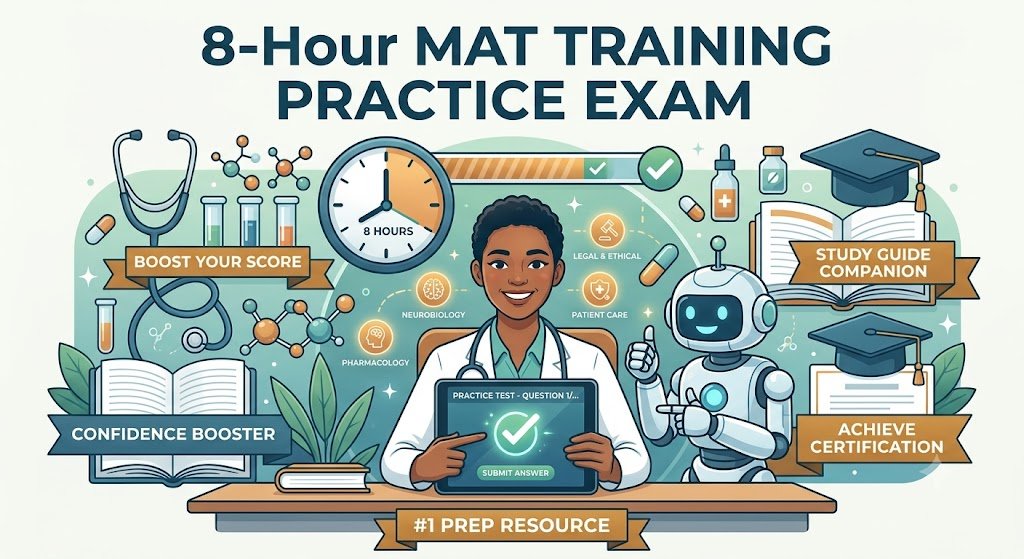
Additional Information
What the Course Entails and Exam Details
The core purpose of the 8-hour MAT training is to equip healthcare providers with the essential knowledge to safely and effectively administer or prescribe medications alongside counseling to individuals suffering from substance use disorders, particularly opioid use. The course curriculum is rigorous and evidence-based, usually adhering to guidelines established by the Substance Abuse and Mental Health Services Administration (SAMHSA) and relevant accrediting bodies. Common modules and topics covered include:
Neurobiology of Addiction: Understanding how opioids affect the brain and why they create a high risk for dependence and disorder.
Pharmacology of MAT Drugs: Comprehensive learning about medications such as Buprenorphine, Naltrexone, and (sometimes, in different settings/trainings) Methadone – their mechanisms of action, formulations, and clinical use.
Patient Assessment and Induction: Protocols for screening, assessing patients for OUD, determining the appropriate medication, and initiating the "induction" process (starting the medication safely).
Stabilization and Maintenance: Management strategies for patients on long-term MAT, adjusting doses, monitoring progress, and handling relapses.
Psychosocial Treatment: Integrating counseling, behavioral therapy, and support services as a vital part of the comprehensive care model.
Legal and Ethical Considerations: Familiarity with the rules, data privacy, and ethical responsibilities involved in MAT, including the evolving landscape of waiver requirements like the DEA MATE Act.
Special Populations: Considerations for managing substance use disorders in pregnant individuals, youth, and those with co-occurring mental health conditions.
The final requirement for the training often involves a completion quiz or exam integrated directly into the educational platform. The core format of this evaluation is almost always multiple-choice. This practice guide is designed to simulate that experience and ensure your mastery of these crucial content areas.
What to Expect in the Final Exam
While the exact structure can vary depending on the specific authorized training provider (e.g., SAMHSA's own platform, various professional organizations), a typical final assessment following an 8-hour MAT training might look like this:
Format: Multiple-choice questions (MCQs). This means you will read a scenario or a question and select the single best answer from a list. The questions will directly test your knowledge of the training content described above. There is usually no practical, in-person component for the training completion requirement itself.
Passing Score: A passing grade is typically required to receive your certificate of completion. This is often around 70-80%, although some programs might require a 100% mastery through retakes.
Time Limit: Expect a reasonable but often structured time limit. This could be anywhere from 60 to 120 minutes, designed to test your understanding within a practical timeframe without rushing you unduly. The 8-hour training period includes learning time; the exam is taken after or during completion of the learning modules.
Delivery and Retakes: The exam is typically delivered online, integrated seamlessly into the training portal. Most programs offer the opportunity for re-takes on the completion quiz until you achieve the passing score, often with direct feedback on incorrect answers to support your learning journey. This guide's practice questions are a valuable asset in this process!
Please always check the specific details provided by your authorized training program to know the exact parameters of their final evaluation.
How to Study and Exam Centers
Effective preparation is key. Here are some actionable strategies to help you conquer your 8-hour MAT training final requirement:
Engage with the Training Material: The best way to succeed is to deeply and actively engage with the course content itself. Do not rush through the modules. Watch all videos, read all texts, and complete all interactive components.
Take Practice Exams: This is the most crucial step! Use the comprehensive practice questions included in this guide, and seek out additional reputable practice resources. Practice exams reveal your strong and weak areas, helping you focus your final review.
Use Active Recall and Flashcards: Don't just re-read your notes. Use active recall. Quiz yourself or a study partner. Create flashcards for critical terms, medication mechanisms, patient assessment steps, and legal requirements.
Simulate Exam Conditions: When taking practice tests, try to simulate real exam conditions. Find a quiet space, set a timer, and resist the urge to look up answers. This helps build your exam-day stamina and time management skills.
Review the Syllabus: Always revisit the key learning objectives of your specific training program. The exam will be built around these, so understanding what you should know is essential.
Form a Study Group: If possible, connect with other healthcare professionals also taking the training. Discussion and peer teaching can solidify complex topics.
Know the Rules for Your Final Evaluation: When you log in for the actual completion requirement, read all instructions carefully. Understand how much time you have and what to do if you encounter technical issues.
Regarding "Exam Centers": The 8-hour MAT training completion quiz is generally taken online, integrated into the learning platform. You would not typically go to a physical testing center like Pearson VUE for this specific training certificate, although other professional licensing or certification exams might be held there. The entire process—from training to assessment and certification—often occurs within the same virtual portal of an authorized provider. Access is typically granted via a personal login. Ensure you have a reliable internet connection and a conducive environment. The training and subsequent exam are widely accessible online, offering flexible learning options for busy healthcare professionals across the globe.
Job Opportunities from the Course
Completing the 8-Hour MAT Training and successfully navigating the associated completion requirement opens doors to impactful career opportunities and significantly expands your ability to provide comprehensive care. The most direct benefit is enabling a wide range of qualified healthcare providers to meet DEA requirements and become waivered to prescribe medications like buprenorphine, a crucial step in treating opioid use disorder. This qualification enhances your practice within many different healthcare settings:
Here is a list of job titles and career paths where this specific MAT knowledge and certification are highly valuable, and often required:
DEA-Waivered Physician (MD/DO) – To prescribe critical MAT medications across various practice settings (Primary Care, Addiction Medicine, Emergency Departments, etc.).
Physician Assistant (PA) – Certified to prescribe or manage MAT patients under supervision or as part of a care team, expanding access.
Nurse Practitioner (NP) / Advanced Practice Registered Nurse (APRN) – Many states allow NPs to obtain waivers and independently practice/prescribe MAT, especially in underserved areas.
Addiction Medicine Specialist – Enhanced credentialing for specialists entirely focused on the treatment of substance use disorders.
Primary Care Provider (PCP) / Family Practice Physician – Integrating MAT into routine primary care helps normalization and access.
Emergency Medicine Physician – Equipping EDs to initiate MAT induction for patients presenting with opioid use issues.
Behavioral Health Counselor / Licensed Clinical Social Worker (LCSW) / Psychologist (integrated roles) – While not prescribers, these vital care team members work with MAT programs, provide counseling, and understand the pharmacology of the medications to better support patients and collaborate with the prescribing team.
Pharmacist (specialized roles) – In some settings, pharmacists play a key role in MAT management, education, and even collaborative practice agreements.
Clinic Administrator / MAT Program Coordinator – Individuals who oversee MAT programs benefit greatly from a deep understanding of the training and operational requirements.
Addiction Medicine Educator / Trainer – Sharing the knowledge with future generations of providers.
Public Health Professional / Policy Analyst – Informed advocacy and policy development around substance use treatment.
By completing this training and passing the final check, you're not just enhancing your résumé; you're joining a dedicated community of providers actively working to save lives and support recovery. This guide and the accompanying practice materials are your roadmap to success in this critical endeavor. Good luck!
Frequently Asked Questions
Reviews
5.0
Based on 0 reviews
Leave a Review
No reviews yet. Be the first to review!