
7B Wood Destroying Pests Practice Exam
$69.00
- Buy to unlock unlimited access to all Quiz questions.
- After purchase you can print a PDF of the whole quiz at any point. The PDF will contain the questions and the correct answers.
About this Exam
The 7B Wood Destroying Pests certification is a specialized
designation designed for structural pest control professionals who identify,
inspect, and treat wood-destroying organisms. These organisms include highly
destructive pests like termites, carpenter ants, and wood-boring beetles, which
can cause significant financial and structural damage to residential and
commercial properties.
This certification is typically a requirement for individuals who apply pesticides (termiticides, etc.) or inspect for these pests as part of their job. If you aim to become a licensed commercial pesticide applicator, an inspector, or a business owner in the pest management industry, this designation is a crucial step in ensuring you are recognized as an expert in the field of wood-destroying pest control. Passing the associated exam demonstrates your proficiency in handling specialized chemicals and protecting valuable structures from these subtle destroyers.
Ready to test your knowledge?
Buy Now to Access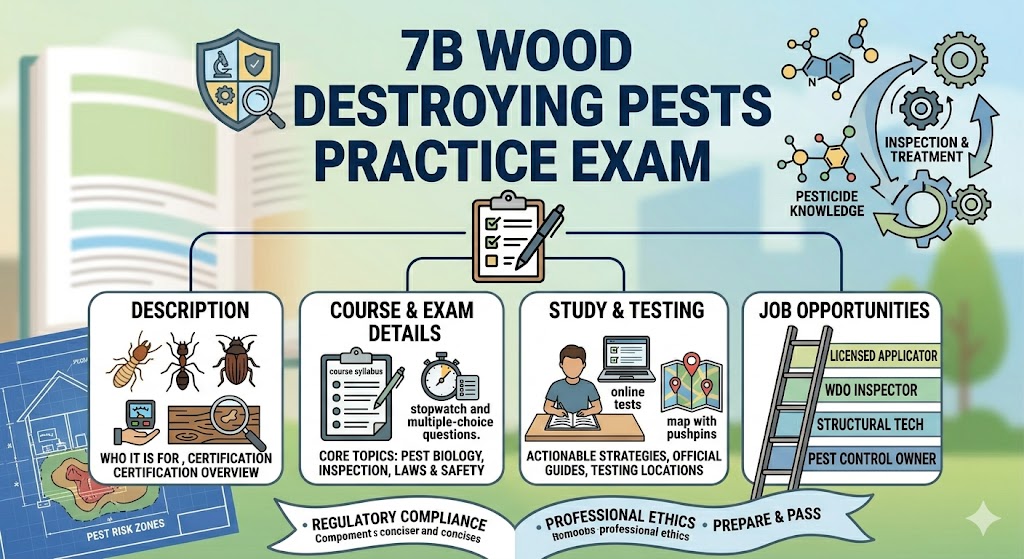
Additional Information
What the Course Entails and Exam Details
This specialized certification program equips candidates
with the foundational knowledge and advanced skills required to manage
wood-destroying organisms. The training material and the subsequent exam focus
on four core areas.
First, you will master the Biology and Behavior of Common
Pests. This includes identification of subterranean termites, drywood
termites, dampwood termites, carpenter ants, powderpost beetles, old house
borers, and wood-decay fungi, along with understanding their life cycles, food
sources, and habitats.
Second, you will learn the art of Advanced Inspection
Techniques. The syllabus covers how to perform thorough structural
inspections, identifying key signs of infestation like mud tubes, exit holes, and
frass, while also assessing conditions that favor infestations, such as
moisture problems or wood-to-soil contact.
Third, the material covers Treatment Methods and
Pesticide Knowledge. You will study the properties of major chemical types,
including termiticides, borates, and fumigants, as well as the calibration of
application equipment, correct mixing procedures, and various treatment methods
like trenching, rodding, sub-slab injection, and baiting systems.
Finally, you must have a thorough understanding of Laws,
Safety, and Environmental Regulations. This includes federal laws like
FIFRA and your specific state's environmental regulations, as well as essential
safety protocols for handling and storing pesticides, understanding the
toxicity of products, using personal protective equipment (PPE), and
recognizing symptoms of pesticide poisoning.
What to Expect in the Final Exam
While exact parameters vary by jurisdiction (e.g., your
specific state's Department of Agriculture or Environmental Management), the 7B
exam is generally structured to test both your conceptual and practical
understanding.
The final exam is typically a written test composed of
multiple-choice questions. It is designed to evaluate your knowledge of pest
identification, treatment strategies, label comprehension, and regulatory
compliance.
You should prepare for a closed-book examination
administered by a proctor. The required passing score is typically between 70%
and 80%, depending on the state’s licensing board.
The time limit for the specialized 7B category exam often
ranges from one to two hours. Because this is a crucial step for commercial
licensing, any attempt at cheating will result in immediate failure and
potential disqualification from future licensing.
How to Study and Exam Centers
Preparing for the 7B Wood Destroying Pests exam requires a
focused study plan. To ensure your success, you must utilize the official
materials. Obtain the most recent state-issued study guide or training manual,
which serves as the ultimate reference for the exam.
Maximize your preparation by using high-quality online
practice tests that specifically target the 7B Wood Destroying Pests
Practice Test. These can help you familiarize yourself with the question
formats, identify knowledge gaps, and build your test-taking speed. Creating
flashcards is also highly effective for memorizing pest characteristics,
pesticide categories, and complex state laws. Consider enrolling in
state-approved training courses or workshops, which often provide practical
training and expert guidance. Joining industry associations like the National
Pest Management Association (NPMA) can offer additional study materials and invaluable
networking opportunities.
When you are ready, the actual certification exams are
administered by official state agencies. You must typically register with your
State Department of Agriculture or Environmental Department to schedule your
testing appointment. Exams may be offered at dedicated government offices,
regional extension centers, or authorized professional testing centers like
Pearson VUE. Ensure you possess and bring all necessary identification and
documentation required by your specific licensing body to your exam.
Job Opportunities from the Course
Earning the 7B Wood Destroying Pests certification unlocks
multiple career pathways within the growing pest management and real estate
industries. This designation proves you have the professional knowledge needed
to secure several specialized roles.
- Pesticide
Applicator (Wood Destroying Category)
- Structural
Pest Control Technician
- WDO
(Wood-Destroying Organism) Inspector (Real Estate Inspections)
- Pest
Management Branch Manager
- Pest
Control Business Owner/Operator
- Termite
Specialist
- Quality
Control Specialist for Pest Companies
Frequently Asked Questions
Reviews
5.0
Based on 0 reviews
Leave a Review
No reviews yet. Be the first to review!