
68W Limited Primary Care (LPC) Practice Exam
$69.00
- Buy to unlock unlimited access to all Quiz questions.
- After purchase you can print a PDF of the whole quiz at any point. The PDF will contain the questions and the correct answers.
About this Exam
The 68W Limited Primary Care (LPC) Practice Exam is an essential tool designed for U.S. Army Combat Medics (MOS 68W) seeking to validate and enhance their skills in a critical subset of their responsibilities. This comprehensive practice test is tailored for experienced 68Ws transitioning into roles or operational environments that require a focused aptitude for administering quality, limited primary medical care with reduced physician oversight. It simulates real-world clinical decision-making scenarios, ensuring medics possess the confidence and knowledge needed to manage non-emergent patient presentations effectively. By focusing on assessment, diagnosis support, and treatment protocols for common conditions, this exam reinforces the foundational principles of primary care within a combat or deployed setting, ultimately supporting force health protection and operational readiness.
Ready to test your knowledge?
Buy Now to Access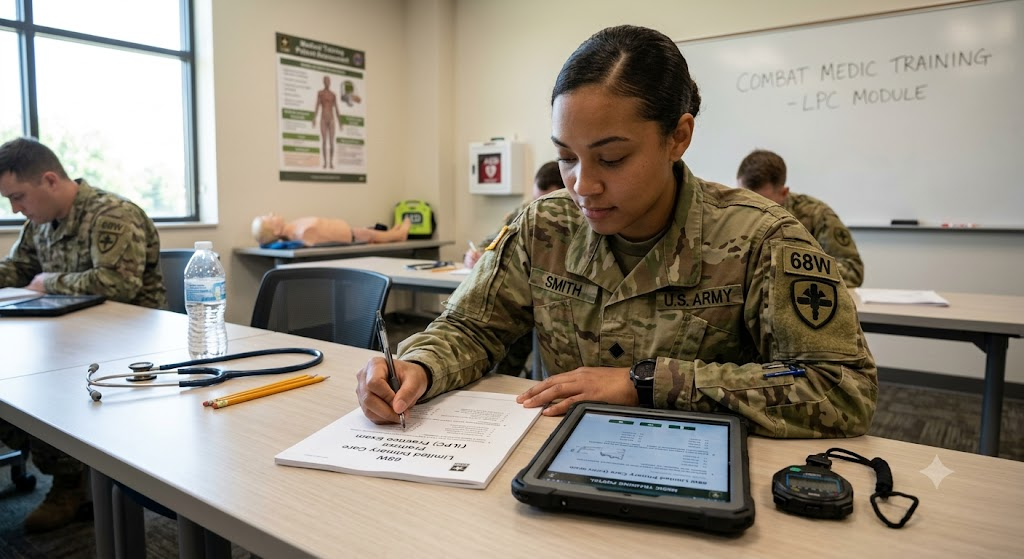
Additional Information
What the Course Entails and Exam Details
This practice exam covers a robust curriculum centered on common clinical situations that a 68W Combat Medic encounters while providing limited primary care. While not a standalone course, it rigorously tests the practical application of knowledge required in an LPC role. Key domains include advanced patient history-taking and physical examination techniques, enabling medics to systematically evaluate a variety of complaints. The exam tests understanding of common infectious diseases, basic dermatology for battlefield conditions, musculoskeletal injuries prevalent in military operations, respiratory and gastrointestinal illness management, and behavioral health screening within primary care. Furthermore, it covers safe and effective pharmacology for standard LPC medications, preventative medicine strategies, and critical skills in standardizing documentation and professional patient hand-offs. The overall focus is on refining the medic's ability to act as a crucial link in the chain of medical care, ensuring continuity and effectiveness within defined parameters.
What to Expect in the Final Exam
While individual providers may differ, a comprehensive 68W Limited Primary Care (LPC) Practice Exam typically utilizes a standard multiple-choice format to assess knowledge across all listed domains. Many exams incorporate detailed clinical scenario-based questions, challenging test-takers to apply their skills in realistic situations rather than just recalling facts. The exam is often structured with a specific time limit to mirror the pressure of real-world patient interactions. Though the specific passing score can vary depending on the educational source or institution administering the test, students should aim for proficiency in all areas. Since this is a practice examination, it is typically accessed through authorized online learning portals or provided within military training environments. Proper identification and authorization from a relevant educational authority or commanding officer may be required for official practice attempts to unlock specific training pathways.
How to Study and Exam Centers
Effective preparation for the 68W LPC Practice Exam requires a strategic approach. Soldiers should begin by thoroughly reviewing materials from their Initial Entry Training (AIT) and any specific LPC-related continuing education courses they have completed. Focus on synthesizing patient assessment algorithms and clinical guidelines for common medical conditions. Utilize flashcards for key medications, dosages, and diagnostic criteria. Form study groups to practice walking through case scenarios and discussing treatment rationale. Simulate the exam environment by taking practice tests under timed conditions to improve speed and focus. Where to take the 68W LPC Practice Exam depends on the specific provider. It is frequently available through official military medical education portals, authorized educational support systems like GoArmy, or specialized training centers within major military installations. Authorized educational institutions or specific training units often provide access to these practice exams as part of a formal curriculum.
Job Opportunities from the Course
Successfully preparing for and utilizing the 68W Limited Primary Care (LPC) Practice Exam can significantly enhance a Combat Medic's career trajectory, both during and after their military service. Demonstrating proficiency in this area opens up a range of advanced and rewarding roles:
Senior Line Medic within Infantry or specialized combat units, with enhanced clinical responsibilities.
Battalion or Brigade-level Medical NCOIC (Non-Commissioned Officer in Charge), leading medical operations.
Flight Medic (following Flight Paramedic training), with advanced clinical assessment skills.
Instructor/Trainer at the Medical Center of Excellence (MEDCoE), shaping the next generation of medics.
Special Operations Combat Medic (SOCM) or within other specialized military units.
Licensed Practical Nurse (LPN) or Licensed Vocational Nurse (LVN) equivalency pathways (may require specific bridge programs).
Civilian Emergency Medical Technician (EMT) roles with advanced protocols (level depends on state regulations).
Primary Care Technician or Medical Assistant in civilian hospitals, clinics, or physician offices.
Occupational Health Specialist support roles in various industries.
Rural or underserved community health roles supporting physician outreach and basic care.
Frequently Asked Questions
Reviews
5.0
Based on 0 reviews
Leave a Review
No reviews yet. Be the first to review!