
WHEBP Standardized Tests & Measurements Practice Test
About this Exam
Welcome to your essential guide for the WHEBP Standardized Tests & Measurements Practice Test!
This exam is expertly designed to validate comprehensive knowledge and practical skills within the critical domain of educational and psychological assessment.
Educators, school counselors, psychologists, and educational leaders frequently pursue this certification to demonstrate their proficiency.
It confirms competence in understanding, selecting, administering, scoring, and ethically interpreting standardized tests across diverse contexts.
Preparing thoroughly with a targeted practice exam is the most effective step towards ensuring your success on this significant assessment.
Ready to test your knowledge?
Start now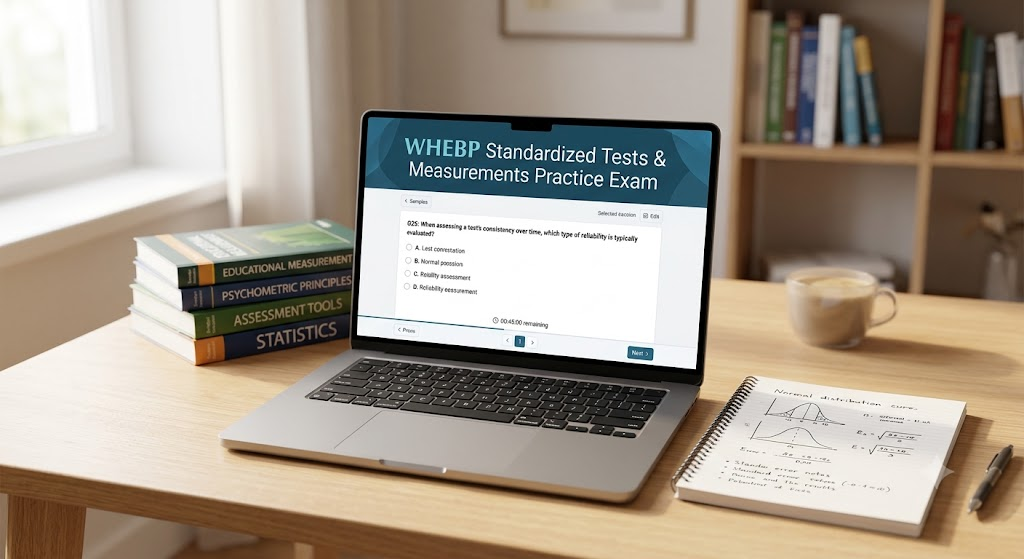
Additional Information
What the Course Entails and Exam Details
The WHEBP Standardized Tests & Measurements curriculum provides a rigorous exploration of foundational concepts.
Students delve deeply into the core principles of measurement, including scaling, norming, and different types of test scores such as z-scores and percentiles.
You will analyze the design and application of diverse assessment tools, spanning academic achievement, cognitive ability, and sometimes personality.
A significant emphasis is placed on thoroughly evaluating assessments using psychometric properties like reliability, which ensures consistency, and validity, confirming accuracy.
Ethical guidelines, legal requirements, optimal test administration procedures, scoring methodologies, and data-driven interpretation strategies for intervention and progress monitoring are all critical components covered in this comprehensive course of study.
What to Expect in the Final Exam
The final WHEBP Standardized Tests & Measurements examination typically follows a multiple-choice format, designed to be comprehensive and objective.
Expect a substantial number of challenging questions that thoroughly evaluate your theoretical understanding and practical application abilities within the specified domains.
While exact details on question count and time limits may vary, candidates generally have several hours to complete the assessment.
To achieve passing status and earn certification, you will need to secure a designated minimum percentage score.
Be prepared for scenario-based questions that require analyzing realistic test data, choosing appropriate assessment tools, and applying ethical frameworks under timed conditions.
Successful time management is crucial to navigating the entire exam effectively within the allotted period.
How to Study and Exam Centers
Diligent and focused preparation is absolutely essential for achieving a passing score on this challenging assessment.
Start by meticulously reviewing your core course materials, textbooks, and detailed class notes, ensuring you have a deep conceptual understanding.
Creating summary charts for key topics like psychometric properties and ethical considerations is a highly effective study technique.
Leveraging high-quality practice tests – particularly those mimicking the actual exam structure and question style – is invaluable for building content knowledge, identifying weak areas, and refining essential time management skills.
Practice not only the recall of facts but also the application of principles to varying educational and psychological scenarios.
Regarding testing logistics, the WHEBP Standardized Tests & Measurements exam is frequently administered through secure online portals with remote proctoring options.
Alternatively, candidates may choose to take the assessment at dedicated physical testing centers or authorized educational institutions, depending on specific program availability and preference.
Be sure to consult official WHEBP resources or your specific program administration for precise and up-to-date details on scheduling procedures and approved testing locations.
Job Opportunities from the Course
Earning proficiency in Standardized Tests & Measurements through the WHEBP exam unlocks numerous career opportunities across the education and psychology sectors.
Specific job titles and career paths this qualification can enhance or lead to include:
K-12 Teacher leveraging assessment data for differentiated instruction.
Special Education Teacher skilled in individual student evaluations.
School Counselor conducting educational planning and placement assessments.
Educational Psychologist performing comprehensive diagnostic evaluations.
Assessment Coordinator managing district-wide testing programs.
Measurement Specialist developing or refining assessment tools.
Educational Researcher analyzing large-scale assessment data for insights.
Test Development Professional creating standardized tests for publishers.
Human Resources Specialist utilizing psychometrics for employee evaluation.
Data Analyst interpreting educational and behavioral statistics.
Mastering these skills positions you as a valuable asset in many professional settings.
Frequently Asked Questions
Reviews
5.0
Based on 0 reviews
Leave a Review
No reviews yet. Be the first to review!