
W!SE Financial Literacy Certification Practice Test
About this Exam
The W!SE Financial Literacy Certification is a prestigious, nationally recognized credential awarded by the organization Working in Support of Education (w!se). This certification is designed primarily for high school and college students to validate their understanding of essential personal finance concepts.
Earning this certification proves that a student has mastered the necessary skills to navigate the complex world of personal money management, from budgeting and saving to understanding credit and insurance. It is a powerful differentiator for students preparing for life after graduation, whether they are entering college or the workforce.
Ready to test your knowledge?
Start now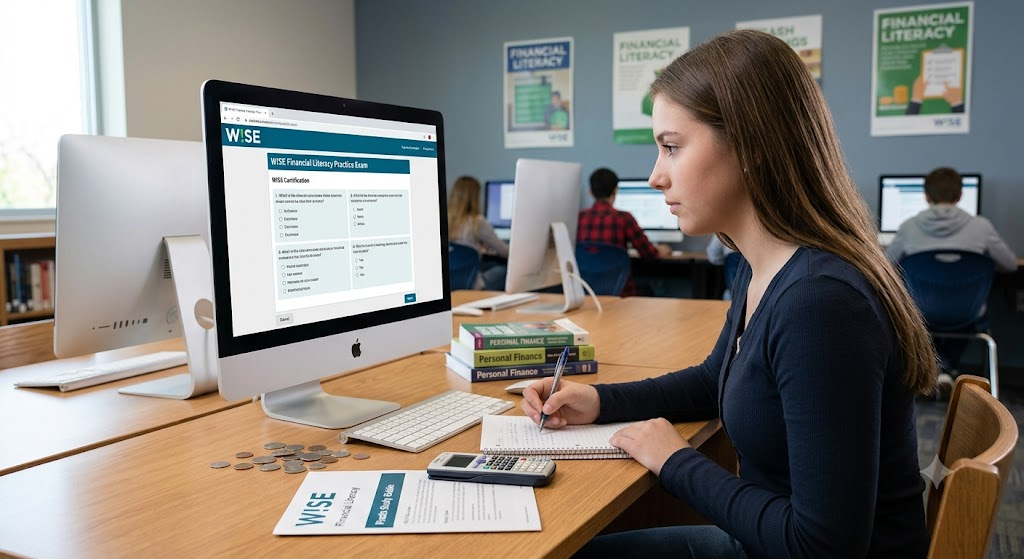
Additional Information
What the Course Entails and Exam Details
The W!SE Financial Literacy curriculum covers a broad and practical spectrum of financial knowledge that everyone needs to build a secure future. The core topics, or domains, generally covered include:
Money Management and Budgeting: Understanding income types, taxes, managing expenditures, and creating a balanced budget.
Banking and Financial Services: Navigating different types of checking and savings accounts, understanding interest rates, and using financial institutions effectively.
Credit and Debt: Analyzing the cost of borrowing, maintaining a healthy credit score, using credit cards responsibly, and understanding types of loans (e.g., student loans, mortgages).
Saving and Investing: Strategies for growing wealth, understanding the power of compound interest, and identifying different investment vehicles (e.g., stocks, bonds, mutual funds).
Insurance and Risk Management: Evaluating need for various types of insurance (health, auto, life, property) and strategies to protect personal assets.
Consumer Rights and Responsibilities: Recognizing fraudulent practices, understanding consumer protection laws, and making informed purchasing decisions.
What to Expect in the Final Exam
Knowing what to expect on test day is crucial for success. The W!SE Financial Literacy Certification Test is a standardized, rigorously proctored exam.
Format: The final exam consists of multiple-choice questions. Each question presents a scenario or definition, requiring test-takers to apply their knowledge to select the best answer.
Number of Questions: The exam typically contains 50 questions.
Time Limit: Students are given approximately 50 minutes to complete the test, meaning you have roughly one minute per question. Pace yourself accordingly.
Passing Score: To earn the designation of "Certified Financially Literate™," students must achieve a minimum passing score of 66 percent.
Rules: The exam is administered under strict proctoring guidelines. Students are not allowed to use external resources, textbooks, cell phones, or unauthorized websites during the test.
How to Study and Exam Centers
Preparation is the key to passing the W!SE exam. Follow these actionable strategies to maximize your chances of success:
Leverage the W!SE Financial Literacy Practice Exam: Take full advantage of official and recognized practice tests. Simulating the timed environment is the single best way to reduce test anxiety and identify your weak areas.
Master Key Vocabulary: Personal finance has its own language. Focus heavily on defining and understanding key terms like "compound interest," "deductible," "amortization," "fiat money," and "asset allocation."
Review Provided Curriculum: Rely on the materials provided by your instructor or the W!SE program. The exam is directly aligned with the topics covered in the standard syllabus.
Practice Scenario Application: The exam doesn't just test definitions; it tests application. Practice solving basic financial math problems (like simple interest) and analyzing credit reports.
Test Center Logistics: The W!SE Financial Literacy Certification Test is usually administered directly within participating high schools, colleges, or authorized educational organizations. It is often an online exam taken under the supervision of a teacher or designated proctor. Contact your school’s guidance counselor or business/finance department to find out when your school administers the test and how to register.
Job Opportunities from the Course
While the W!SE Financial Literacy Certification is not a license to practice (like a CPA), it serves as a powerful foundational credential. It signals to employers that you are responsible, financially literate, and possess strong analytical and decision-making skills. It is highly valued in various sectors, particularly for entry-level roles.
Career Paths and Job Titles This Certification Unlocks:
Bank Teller
Customer Service Representative (Financial Services)
Entry-Level Bookkeeper
Account Clerk
Loan Processor (Entry-Level)
Insurance Sales Assistant
Sales Associate (High-Ticket Retail or Commission-based)
Office Administrator
Budget Analyst (Junior Role)
Real Estate Administrative Assistant
Entrepreneur/Small Business Owner (Provides essential financial foundation for success)
This certification is also excellent preparation for more advanced financial certifications and degrees in finance, accounting, or economics.
Frequently Asked Questions
Reviews
5.0
Based on 0 reviews
Leave a Review
No reviews yet. Be the first to review!