
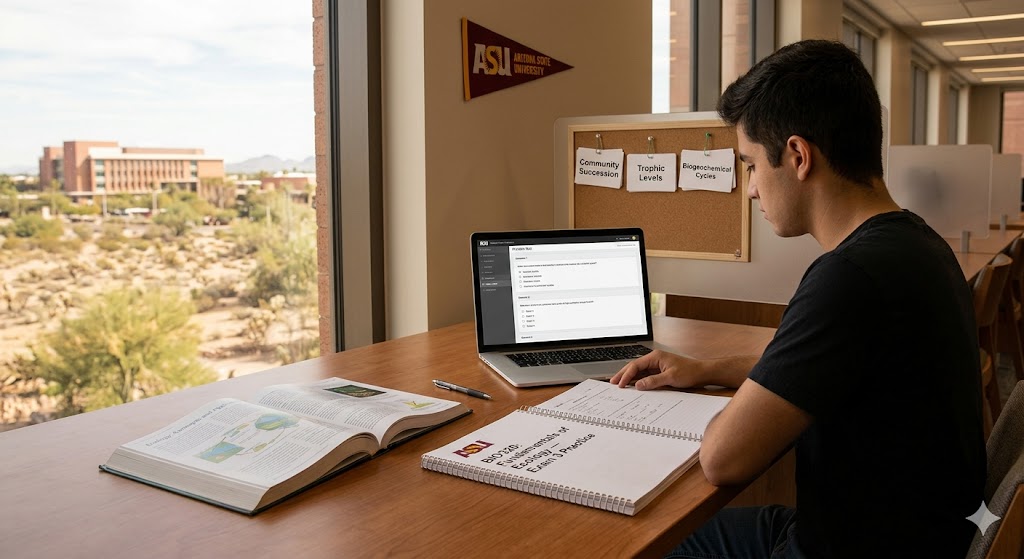
ASU BIO320 Fundamentals of Ecology Exam 3 Practice
Looking for More?
Check out our comprehensive package plans for ultimate prep materials and exams!
View All PackagesDescription
The Arizona State University (ASU) BIO320 Fundamentals of
Ecology Exam 3 is a crucial academic milestone for undergraduate students
pursuing degrees in biological sciences, conservation biology, and
environmental engineering.
This exam is designed to rigorously test a student's
synthesized understanding of complex ecological principles, particularly those
that operate at the community and ecosystem levels.
It is a prerequisite test that confirms a student's
readiness to advance into upper-division coursework in specialized
environmental fields, ensuring they possess the analytical and conceptual
skills needed for real-world ecological management.
Ready to test your knowledge?
Start nowAbout this Quiz
What the Course Entails and Exam Details
BIO320 is a comprehensive course that moves beyond
organismal biology to investigate the intricate relationships that form entire
biological communities and ecosystem-level processes.
Exam 3 typically focuses on the latter half of the course
curriculum, which often includes critical modules like community structure,
succession, biodiversity patterns, and food web dynamics.
Students are expected to master ecosystem ecology concepts,
such as primary and secondary production, decomposition, nutrient cycling, and
the overarching flow of energy through trophic levels.
The exam details a strong emphasis on applying mathematical
models to analyze data, such as interpreting diversity indices, calculating
productivity rates, or predicting ecological succession outcomes, making
numerical competency essential for success.
What to Expect in
the Final Exam (relabel to Exam 3)
While exact structures can vary between instructors, a
standard BIO320 Exam 3 is a comprehensive 100-point test that challenges
students through multiple-choice questions, data interpretation, and
short-answer prompts.
You should expect the format to be highly conceptual, often
asking you to apply a theory to a new scenario rather than simply recall
definitions.
The passing score is determined by the university's standard
grading scale, but a grade of 'C' or higher is generally required for the
course to count towards a concentration in conservation or ecology.
The time limit for a lecture-period exam is usually 50 to 75
minutes, and it is a proctored, closed-book assessment, meaning no outside
materials are allowed during the testing session.
How to Study and Exam Centers
Effective study requires a two-pronged approach: rigorous
conceptual review and hands-on practice.
I highly recommend prioritizing your lecture notes and
drawing out complex diagrams, such as the carbon and nitrogen cycles, or food
web interactions, to visual the connections between different ecological
compartments.
Use practice exams from previous semesters or create your
own, focusing on calculating indices like Shannon-Wiener diversity or solving
production problems to build your quantitative skills.
For exam centers, ASU students take their BIO320 exams in
one of two ways.
If you are a student in an immersion (in-person) program,
your exam will be administered by the instructor in your designated lecture
hall on an ASU campus, such as Tempe or Polytechnic.
If you are enrolled in an ASU Online program, you will use
ASU's authorized online proctoring service (e.g., Honorlock or RPNow), which
requires a compatible webcam, microphone, and a secure, private testing
environment.
Job Opportunities from the Course
Mastering BIO320 opens doors to a wide range of career paths
in both the public and private sectors.
Specific job titles unlocked by a biology or conservation
degree featuring this course include:
- Ecologist:
Conducting field surveys and analyzing data to assess ecosystem health.
- Environmental
Consultant: Advising organizations on environmental risks and
compliance.
- Conservation
Officer: Managing natural resources and wildlife habitats for public
agencies or non-profits.
- Wildlife
Biologist: Studying animal populations and their interactions with the
environment.
- Sustainability
Manager: Developing strategies for organizations to reduce their
ecological footprint.
- Research
Assistant: Assisting in advanced university or government research
projects.
- Environmental
Educator: Designing outreach programs to promote environmental awareness
and action.
- Geographical
Information Systems (GIS) Technician: Using spatial data to map
habitats and species distributions.
- Fisheries
Biologist: Managing aquatic ecosystems for sustainable use.
Frequently Asked Questions
Reviews
5.0
Based on 0 reviews
Leave a Review
No reviews yet. Be the first to review!
Looking for More?
Check out our comprehensive package plans for ultimate prep materials and exams!
View All Packages