
Aquatic Pest Management & Aquatic Science Practice Exam
Looking for More?
Check out our comprehensive package plans for ultimate prep materials and exams!
View All PackagesDescription
Description
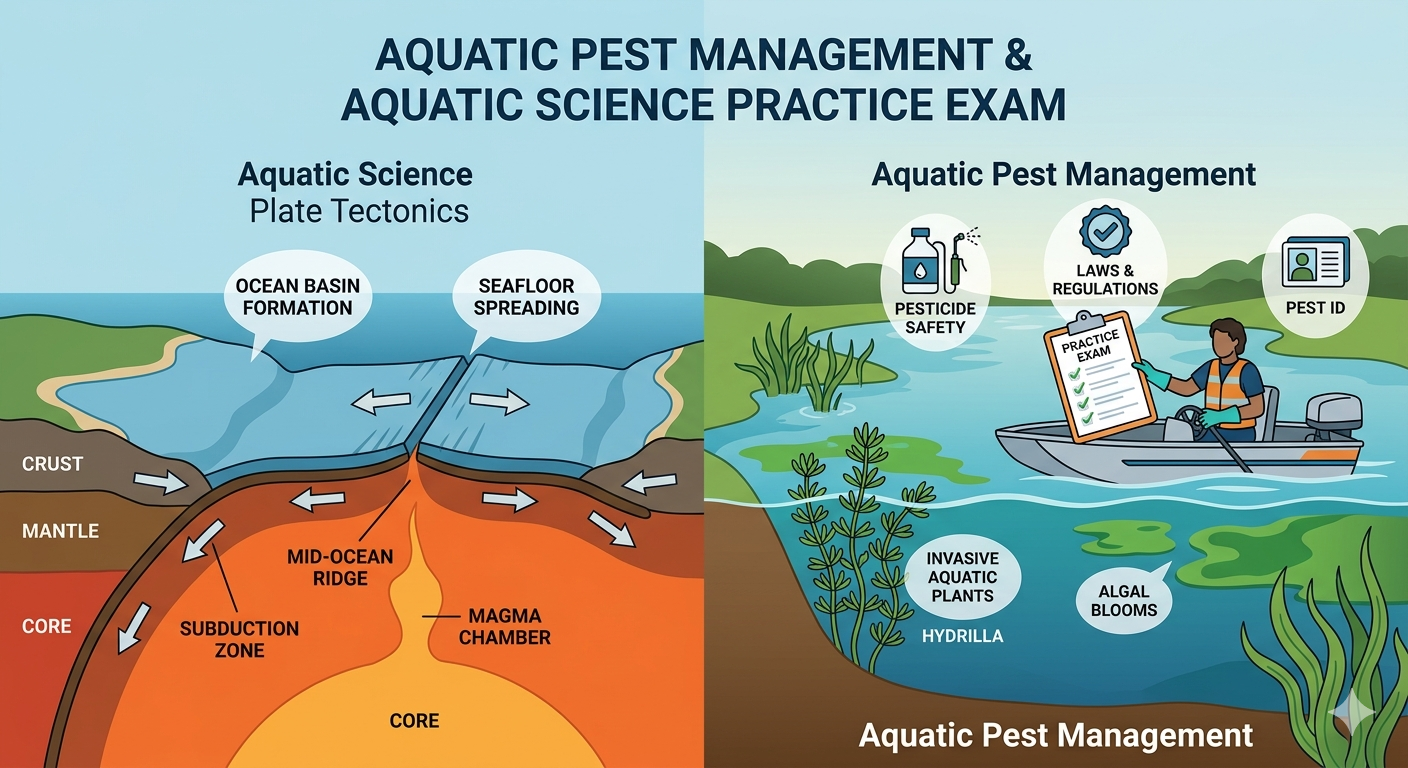
The Aquatic Pest Management (Aquatic Science Plate Tectonics Practice Test) is a unique, specialized exam designed for students and professionals bridging the gap between environmental management and earth science. It assesses proficiency in managing invasive aquatic species and understanding the foundational geological processes that create their habitats. This practice exam is ideal for aspiring Aquatic Pesticide Applicators, Environmental Scientists, Wetland Ecologists, and High School Science students specializing in Earth or Marine Systems. By mastering this practice test, candidates demonstrate their readiness to handle complex ecological challenges, from controlling detrimental algal blooms to predicting habitat changes driven by continental drift.
Ready to test your knowledge?
Start nowAbout this Quiz
What the Course Entails and Exam Details
The comprehensive syllabus for this certification requires a dual understanding of chemical safety and global geology. Students must prepare to demonstrate knowledge across two distinct domains:
Core Topics Covered:
Pesticide Safety & Regulations: Federal and State laws governing the application of pesticides in or near water bodies, understanding the pesticide label, handling, and disposal.
Aquatic Pest Identification: Recognizing common invasive weeds (e.g., Hydrilla, Water Hyacinth), harmful algae, and invertebrate pests.
Integrated Pest Management (IPM) in Water Systems: Biological, physical, and chemical control methods, and calculating treatment volumes for ponds and lakes.
Plate Tectonics Principles: The theory of continental drift, seafloor spreading, and evidence for plate motion.
Plate Boundaries and Features: Divergent boundaries (mid-ocean ridges), convergent boundaries (subduction zones), transform boundaries, and hotspot formation.
The Geology of Aquatic Systems: Understanding how plate tectonics shapes ocean basins, trenches, and freshwater lake systems over geological time.
What to Expect in the Final Exam
While the format can vary slightly depending on the authorizing state agency or educational institution, the final exam typically follows a standardized structure. The exam is designed to test both theoretical knowledge and practical application scenario reasoning.
Standard Final Exam Parameters:
Exam Format: The test is usually comprised of 50 to 100 multiple-choice questions. These questions are divided between the Pest Management section (focusing on scenarios and math) and the Plate Tectonics section (focusing on diagrams and definitions).
Passing Score: A minimum score of 70% to 75% is generally required to pass.
Time Limit: Candidates typically have 90 minutes to two hours to complete the exam.
Specific Rules: Most versions of the exam allow the use of a simple, non-programmable calculator for pesticide application mathematics. It is closed-book, and no outside reference materials are allowed. For students taking it through a school system, it might be a standard end-of-unit assessment rather than a state certification exam.
How to Study and Exam Centers
Effective preparation for this diverse test requires a structured approach that tackles both the pesticide safety data and the geological science material.
Actionable Study Strategies:
Master the Math: Spend significant time practicing "Category 5" pesticide application math. You must be able to calculate surface area, volume, and the necessary quantity of chemical for a treatment area accurately.
Diagram Practice: Draw and label diagrams of the types of plate boundaries (convergent, divergent, transform). Ensure you can identify which features (e.g., trenches, ridges, volcanoes) form at which boundary type.
Use Flashcards for ID and Laws: Create flashcards for identification of common aquatic pests and for key regulatory terms and timelines.
Take the Practice Test: Use our provided Aquatic Pest Management (Aquatic Science Plate Tectonics Practice Test) repeatedly. Simulate real exam conditions by timing yourself to build confidence and speed.
Where to Take the Exam:
Pesticide Applicator Certification: If you are pursuing professional licensing, exams are administered by your State’s Department of Agriculture. Testing usually occurs at regional Department of Agriculture offices or authorized physical testing centers (such as local community colleges).
Educational Exam: If you are a student taking this as part of an Aquatic Science or Earth Science course, the exam will be administered directly through your high school or college by your instructor, either in class or via an online learning portal.
Job Opportunities from the Course
A strong performance on this exam signals specialized knowledge that is highly valued in the environmental and geological sectors. This dual expertise can unlock various rewarding career paths.
Job Titles unlocked by this training:
Certified Aquatic Pesticide Applicator
Lake and Pond Management Specialist
Wetland Restoration Technician
Environmental Science Technician
Fisheries Management Assistant
Aquatic Ecologist I
Coastal Zone Management Assistant
Earth Science Education Assistant
Frequently Asked Questions
Reviews
5.0
Based on 0 reviews
Leave a Review
No reviews yet. Be the first to review!
Looking for More?
Check out our comprehensive package plans for ultimate prep materials and exams!
View All Packages