
Clover Learning Rad Tech Boot Camp Practice Test
About this Exam
The Clover Learning Rad Tech Boot Camp Practice Test is a crucial preparatory tool for students and recent graduates of Radiologic Technology programs. It is specifically designed to simulate the experience and content of the American Registry of Radiologic Technologists (ARRT) Radiography certification exam. This practice test is intended for individuals aiming to become Registered Technologists in Radiography (R.T.(R)). By using this resource, students can assess their readiness, identify critical knowledge gaps, and build the endurance needed to succeed on the actual licensure exam, which is the final step toward a rewarding career in medical imaging.
Ready to test your knowledge?
Start now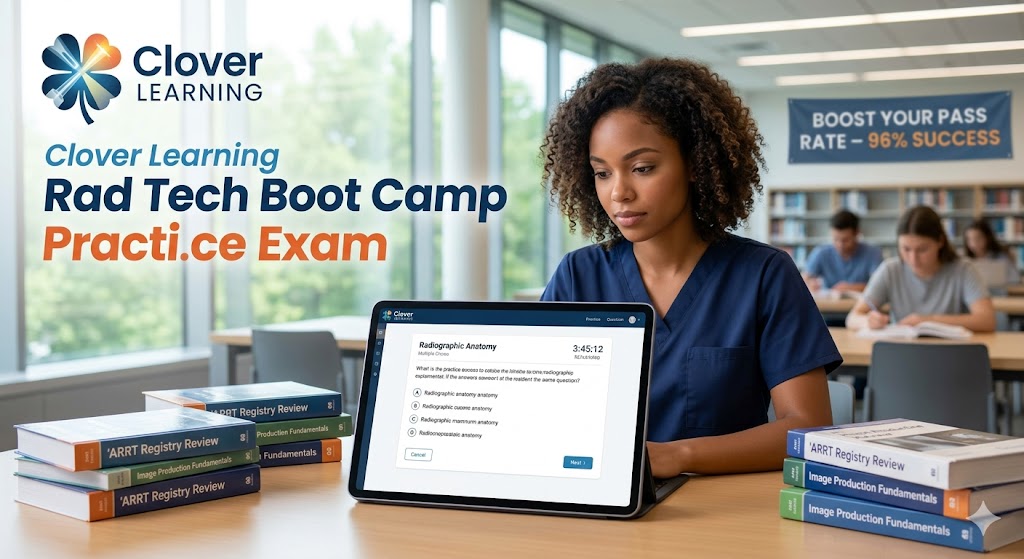
Additional Information
What the Course Entails and Exam Details
This practice test is a comprehensive synthesis of the core curricula taught in accredited Radiologic Technology programs. It covers the four primary domains mandated by the ARRT content specifications.
First, Patient Care assesses knowledge of patient interactions, safety protocols, medical emergencies, and contrast media administration. Second, Safety focuses on radiation physics, radiobiology, and strict adherence to ALARA (As Low As Reasonably Achievable) principles for both patients and personnel.
Third, Image Production covers the technical aspects of creating diagnostic images, including equipment operation, digital imaging parameters, image artifacts, and quality control. Finally, Procedures evaluates understanding of anatomy, positioning for all body systems, and the specific technical factors required for various radiographic examinations.
What to Expect in the Final Exam
When taking the Clover Learning mock exam, students should expect a format that closely mirrors the official ARRT Registry. The practice test consists of multiple-choice questions delivered through a computer-based interface.
The time limit is designed to mimic the pacing of the actual 4-hour ARRT exam, encouraging students to manage their time efficiently. While Clover Learning provides immediate scoring and feedback for study purposes, the actual ARRT exam requires a scaled score of 75 to pass.
It is important to treat the practice test as a "dress rehearsal," taking it in a quiet environment without interruptions to accurately gauge your exam-day readiness. The questions are designed to test not only recall but also the application of clinical knowledge to situational scenarios.
How to Study and Exam Centers
Effective study begins with treating the practice test as a diagnostic tool. Take an initial mock exam to identify your weakest domains.
Once identified, return to the Clover Learning Boot Camp video lessons and interactive modules to reinforce those specific areas. Create flashcards for complex concepts in radiation physics or procedural positioning.
A critical study strategy is to review not just the questions you got wrong, but also the questions you guessed correctly. Understanding the rationale behind the correct answer is key to long-term retention.
Regarding exam locations, the Clover Learning Practice Test itself is taken entirely online through their proprietary portal, accessible from any compatible computer with internet access. However, the actual ARRT certification exam must be taken in person at an authorized Pearson VUE testing center. These centers are located globally, and you must schedule your official appointment after receiving your eligibility letter from the ARRT.
Job Opportunities from the Course
Successfully passing your classes and using the Boot Camp to ace the ARRT Registry unlocks numerous career pathways in medical imaging. Certified Radiologic Technologists are in high demand across the United States. Potential job titles and career paths include:
Staff Radiographer (R.T.(R)): Performing general X-rays in hospitals, clinics, and urgent care centers.
Computed Tomography (CT) Technologist: Specializing in advanced cross-sectional imaging (often requires additional certification).
Magnetic Resonance Imaging (MRI) Technologist: Utilizing strong magnetic fields for diagnostic imaging (post-primary pathway).
Mammographer: Specializing in breast imaging and cancer detection.
Interventional Radiology (IR) Technologist: Assisting physicians in minimally invasive, image-guided procedures.
Cardiac Catheterization Lab Technologist: Working in high-paced environments to image the heart and dynamic blood flow.
Orthopedic Radiographer: Working in specialized clinics focusing on bone and joint health.
Radiology Administrator/Manager: Moving into leadership roles within imaging departments after gaining clinical experience.
Radiologic Technology Educator: Teaching the next generation of technologists in academic settings.
Frequently Asked Questions
Reviews
5.0
Based on 0 reviews
Leave a Review
No reviews yet. Be the first to review!