
Chicago Fire EVOC Practice Exam
About this Exam
Welcome to your essential first step toward mastering the
high-stakes world of emergency vehicle operation within the nation's busiest
systems. The CFD Emergency Vehicle Operations Course (EVOC) Certification is a
foundational credential required for Chicago Fire Department personnel, first
responders, and private ambulance operators who must navigate marked emergency
vehicles—fire apparatus and ambulances—safely and efficiently under emergency
conditions. This comprehensive course and the culminating practice exam are
explicitly designed to train experienced drivers to apply critical thinking and
precision handling under intense pressure. Earning this certification validates
your understanding of complex legal responsibilities, unique vehicle dynamics,
and advanced defensive driving techniques, proving you possess the complex
reasoning skills required to minimize risk while ensuring "due
regard" for public safety.
Ready to test your knowledge?
Start now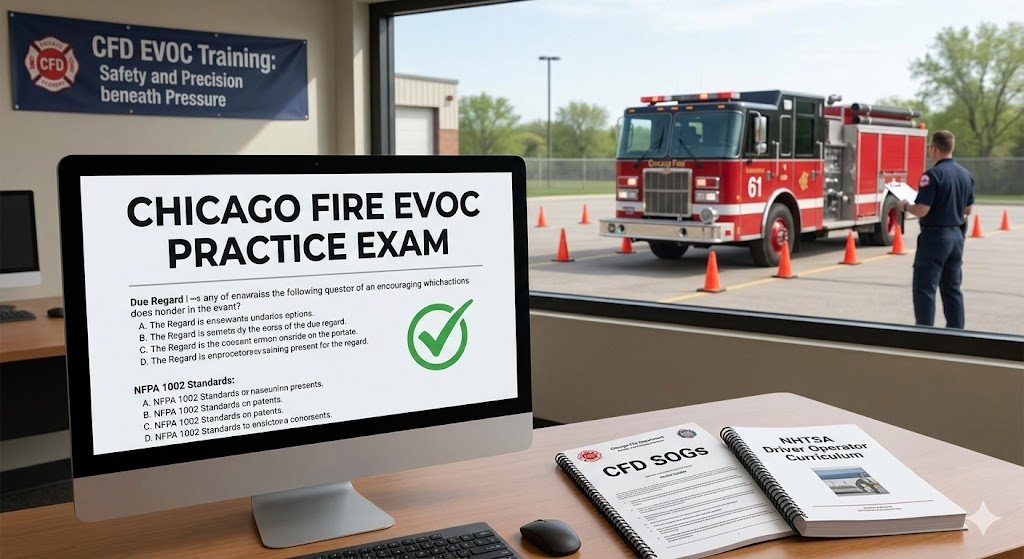
Additional Information
What the Course Entails and Exam Details
To prepare for the final validation, the EVOC program blend
dynamic classroom instruction with intensive hands-on driving scenarios,
adhering to professional standards such as NFPA 1002 (Fire Apparatus) or NHTSA
(Ambulance) National Standard Curricula. Mastery of these concepts is essential
to distinguish your performance from entry-level understanding.
Key topics and skills validated by the underlying course
include:
- Laws
and Liabilities: Mastering standard legal terminology ("due
regard" and "Code-3 tactics") and understanding state and
municipal vehicle codes governing emergency response.
- Defensive
Driving Principles: Applying sophisticated strategies for collision
avoidance, intersection management, space management, and analyzing
traffic patterns while under stress.
- Vehicle
Characteristics and Dynamics: In-depth study of high center of gravity
dynamics, rollover prevention, weight transfer, braking techniques, and
inspection protocols specific to large apparatus.
- Emergency
Mode Operations: Safe procedures for using lights and sirens,
proceeding against right-of-way, and identifying negative right-of-way
situations.
- Advanced
Maneuvering Skills: Training on the dynamics of backing apparatus,
managing distracted driving, and navigating adverse weather conditions.
What to Expect in the Final Exam
The final CFD EVOC assessment is generally structured as a
robust, two-part evaluation consisting of a theoretical written exam and a
practical skills test. Your overall competency validation demands exceptional
performance in both domains.
Written Examination: The theoretical component is
typically a comprehensive multiple-choice examination. You can expect the final
written test to consist of approximately 50 to 100 objective questions covering
state laws, departmental standard operating procedures (SOPs), and the
principles of defensive driving covered in class. Candidates must achieve a
minimum scaled score, often 70% to 80%, to pass this section. This portion is
usually proctored and may be strictly closed-book, with time limits set around
60 to 90 minutes.
Practical Skills Evaluation: The practical evaluation
is the engine of the certification, testing your precision beneath stressful
conditions. This pass/fail examination requires candidates to deduce difficult
maneuvering solutions while navigating a precisely defined cone course in a
full-sized emergency vehicle. You must demonstrate mastery over standard
NFPA/NHTSA exercises, which may include the Serpentine, Diminishing
Clearance, Straight Line Braking, Backing with Mirrors, U-Turn,
and Three-Point Turn. Evaluation is accuracy-based rather than
time-based; you are judged on steering control, mirror usage, smooth
application of physical forces, and avoiding cone contacts. Proper backing
techniques with an assistant may also be tested beneath supervised observation.
How to Study and Exam Centers
Achieving success demands a proactive and dedicated study
routine that prioritizes active recall and simulated application. Actionable
study strategies include focusing heavy emphasis on memorizing your specific
departmental SOGs, especially regarding siren usage and maximum speeds. We
highly recommend utilizing our realistic Chicago Fire EVOC Practice
Questions bank to identify knowledge gaps, practice theoretical logic, and
build mental stamina beneath simulated time pressure. Consider developing
detailed flashcards for legal definitions, Code-3 restrictions, and standard
vehicle inspection checkpoints. If taking an online version of the course,
dedicate focused blocks of time to review video simulations and traffic
analysis scenarios.
Practical Practice Methods: The practical component
requires advanced deducing of safe maneuvers. Familiarize yourself with
standard cone course dimensions and practice low-speed maneuvering in large
vehicles, if possible, beneath the surface of official training hours.
Visualize the required steering inputs and reference points for challenging
maneuvers like the serpentine and diminished clearance exercises.
Exam Centers: The final examination is administered
beneath the authority having jurisdiction (AHJ), usually at establishing
municipal or department-specific training facilities. For the written exam, you
may access the test through authorized educational portals, online portals, or
specialized computerized testing systems. The practical skills evaluation will
always occur at a dedicated, secure physical examination centers, such as the Chicago
Fire Department Academy’s driving range or specialized authorized physical
testing centers provided by standardized testing vendors. Ensure you check
registration deadlines and specific center guidelines well in advance.
Job Opportunities
from the Course
A successfully achieved CFD EVOC Certification serves as a
dynamic catalyst, distinguishing you as a dedicated first responder ready for
high-stakes responsibilities beneath the surface of immediate response. Mastery
of this standard is considered an ideal prerequisite validation point for
numerous prestigious and critical roles within fire services, EMS, and
municipal operations.
Graduates of the course and certificate holders are highly
sought after for prestigious job titles, including:
- Firefighter/Engineer
- Apparatus
Operator
- Fire/EMS
Driver/Operator
- Critical
Care Paramedic
- EMS
Apparatus Driver
- Private
Ambulance Operator
- Municipal
Emergency Services Operator
- Airport
Rescue Fire Fighter (ARFF) apparatus driver
- Wildland
Fire apparatus operator
Frequently Asked Questions
Reviews
5.0
Based on 0 reviews
Leave a Review
No reviews yet. Be the first to review!