
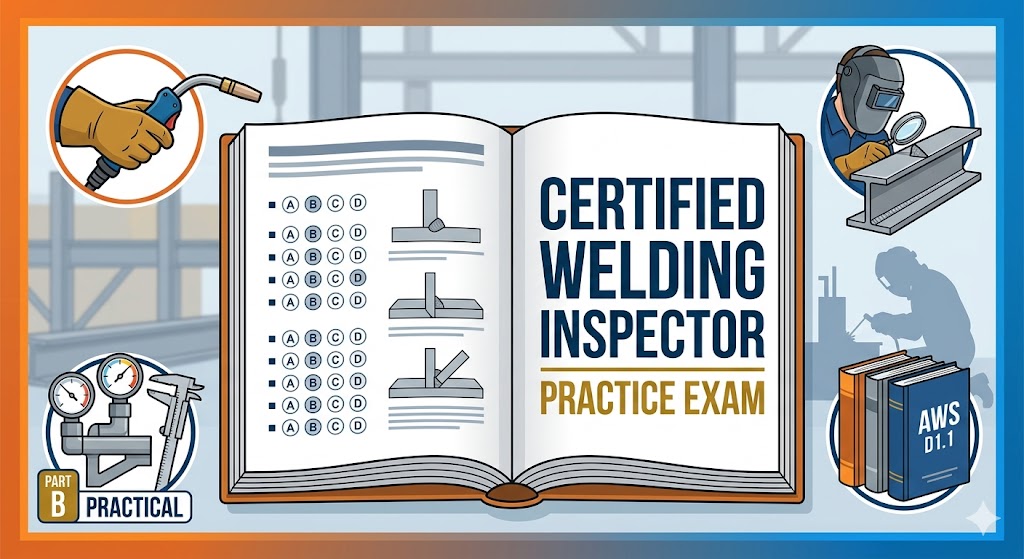
Certified Welding Inspector Practice Exam
Looking for More?
Check out our comprehensive package plans for ultimate prep materials and exams!
View All PackagesDescription
The Certified Welding Inspector (CWI) credential is one of
the most respected and recognized certifications in the construction and
manufacturing industries. Developed and administered by the American Welding
Society (AWS), this certification mandates that individuals possess a specific
level of knowledge and skill regarding welding processes, inspection
procedures, and code compliance. It is designed for experienced welding
professionals—such as welders, supervisors, quality control technicians, and engineers—who
are looking to advance their careers into quality assurance and inspection
roles. Earning your CWI card demonstrates a commitment to quality, safety, and
professional excellence, authenticating your ability to ensure that welded
structures meet strict industry standards.
Ready to test your knowledge?
Start nowAbout this Quiz
What the Course Entails and Exam Details
The path to becoming a CWI is rigorous and requires a deep
understanding of both theoretical concepts and practical applications. While
AWS does not require a specific "course," most candidates attend a
preparatory seminar. The "syllabus" of knowledge required for the CWI
exam is expansive and covers the following core domains:
- Welding
Processes: A comprehensive understanding of major processes including
SMAW, GMAW, FCAW, GTAW, SAW, and ESW.
- Heat
Control & Metallurgy: Knowledge of the properties of carbon and
low-alloy steels and how welding affects their microstructure and
mechanical properties.
- Weld
Examination: Familiarity with destructive testing (such as tensile,
bend, and impact tests) and Nondestructive Examination (NDE) methods (VT,
PT, MT, UT, and RT).
- Documents
& Inspector Responsibilities: The ability to review and verify
Welding Procedure Specifications (WPS), Procedure Qualification Records
(PQR), and Welder Performance Qualification (WPQ) reports.
- Weld
Discontinuities: The visual identification of weld flaws, such as
porosity, slag inclusions, cracks, undercut, and incomplete fusion, and
understanding their causes and acceptance criteria.
- Symbols
& Definitions: Mastering welding symbols on drawings and standard
welding terminology (per AWS A3.0).
- Mathematical
Calculations: Applying basic formulas relevant to welding inspection,
dimensions, and standard units.
What to Expect in
the Final Exam
The CWI final exam is a comprehensive, three-part assessment
designed to test every facet of an inspector's competence. You must understand
the structure of this long and demanding day. To earn the CWI credential,
successful candidates must achieve a minimum score of 72% on each of the
three parts. It is not an average; a failure on any single part requires a
retake of that section.
Part A: Fundamentals (150 Questions)
This is a two-hour, closed-book, computer-based test (CBT)
that covers the theoretical knowledge of welding. You will have exactly 120
minutes to answer 150 multiple-choice questions. This requires speed and
accuracy, as you have less than one minute per question. The questions are
pulled from the breadth of welding logic, terminology, and standard practices.
Part B: Practical Inspection (Minimum 46 Questions)
This is the hands-on portion of the exam, also lasting two
hours (120 minutes). During Part B, you will be provided with visual inspection
tools, plastic weld replicas, and a unique "Book of Specifications."
You will be required to use the provided tools to measure and evaluate the
replicas against the requirements found in the supplied specification book. You
may need to inspect welds, interpret procedure specifications, and determine
the acceptability of test results.
Part C: Codebook Application (50-60 Questions)
Part C is an open-book exam that tests your ability to
navigate, interpret, and apply a specific welding code. You must select which
code you will be tested on during application (most candidates choose AWS
D1.1, Structural Welding Code—Steel, or API 1104, Welding of
Pipelines). This part typically lasts two hours (120 or 135 minutes, depending
on the number of questions, which includes non-scored pretest items). You must
locate specific clauses, tables, and figures to answer multiple-choice
questions regarding qualification, fabrication, inspection, and records.
How to Study and
Exam Centers
Actionable Study Strategies
- Master
the Navigation: For Part C, your success depends on how quickly you
can find information. Do not try to memorize the codebook. Instead, use
index tabs and create a mental map of the clauses. You need to know
exactly which section handles "Welder Qualification" versus
"Fabrication." Practice navigating the code until you can locate
any topic in under two minutes.
- Hands-on
Tool Practice: You cannot pass Part B without fluency in inspection
tools. Purchase or borrow a set of standard gauges (fillet weld gauge,
V-WAC gauge, micrometer, etc.) and practice measuring actual welds or
practice replicas. Memorize the proper way to use and read each tool.
- Simulate
Test Conditions: Take full-length, timed practice exams. For Part A,
this is crucial for building the endurance needed to answer 150 questions
quickly. It will help you identify weak points in your foundational
knowledge.
- Attend
an AWS Seminar: Highly recommended, AWS offers week-long preparatory
seminars that cover all three parts of the exam. They provide expert
instruction and hands-on practice with the tools and replicas used in the
actual Part B.
Where and How to Take the Exam
The CWI exam is administered in a hybrid format:
- Computer-Based
Testing (Parts A and C): Part A (Fundamentals) and Part C (Codebook)
are administered via computer at authorized Prometric testing
centers. These centers are located globally, allowing you to schedule your
computer-based tests at a convenient time and location once your
application is approved by AWS.
- Physical
Testing Centers (Part B): Part B (Practical) is a physical, proctored
exam. You cannot take this part at a computer center. Part B is
administered at specific locations, often adjacent to AWS Seminars in
major cities, or at AWS Accredited Test Facilities (ATFs) and other
authorized schools that are equipped with the required standard inspection
tools and replicas. You must check the AWS schedule to find a specific
Part B exam date and location.
Job Opportunities
from the Course
Earning the Certified Welding Inspector certification is a
definitive career milestone that unlocks numerous specialized job titles and
significant salary increases across industrial, structural, and infrastructure
sectors. It validates you as a qualified professional rather than just a
skilled tradesperson. Here is a list of job titles and career paths available
to a CWI:
- Certified
Welding Inspector (CWI)
- Quality
Control (QC) Inspector
- Quality
Assurance (QA) Supervisor
- Welding
Supervisor
- Welding
Instructor / Educator
- Third-Party
Agency Inspector
- Vendor
Surveillance Inspector
- Structural
Steel Inspector
- Pipeline
Inspector
- Boiler
and Pressure Vessel Inspector
- Plant
Maintenance Inspector
- Nondestructive
Examination (NDE) Coordinator
- Welding
Coordinator / Consultant
Frequently Asked Questions
Reviews
5.0
Based on 0 reviews
Leave a Review
No reviews yet. Be the first to review!
Looking for More?
Check out our comprehensive package plans for ultimate prep materials and exams!
View All Packages