
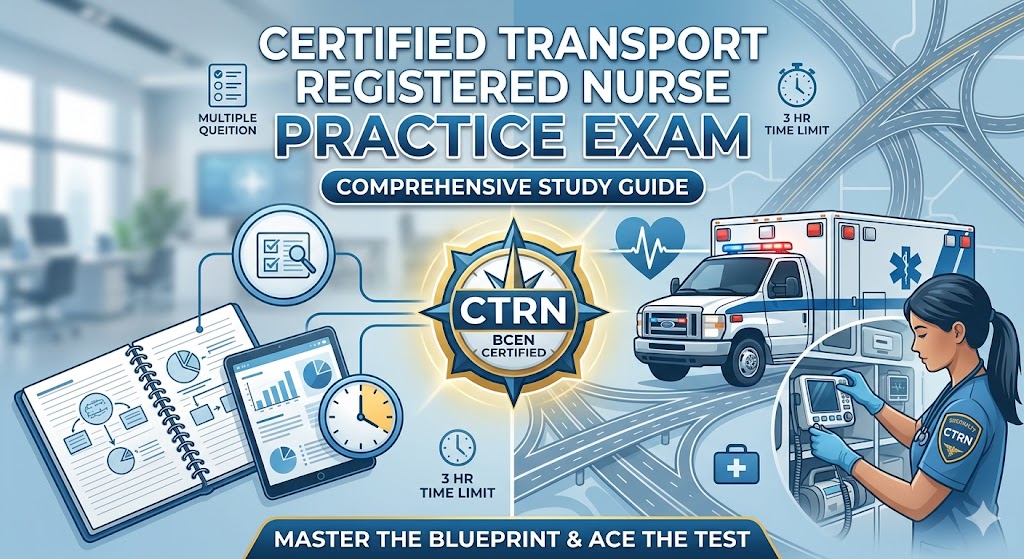
Certified Transport Registered Nurse Certification Practice Exam
Looking for More?
Check out our comprehensive package plans for ultimate prep materials and exams!
View All PackagesDescription
The Certified Transport Registered Nurse (CTRN)
certification is the premier credential for registered nurses engaged in the
vital field of critical care ground transport. Administrated by the Board of
Certification for Emergency Nursing (BCEN), the CTRN validates that you possess
the advanced critical thinking skills, high-level knowledge, and specialized
clinical judgment necessary to manage diverse patient populations safely during
ground transport. This certification is specifically designed for RNs with at
least two years of critical care experience who are seeking to master the
unique operational and medical challenges that occur outside the static
hospital environment. Achieving your CTRN signals to employers, colleagues, and
patients your dedication to delivering the highest quality critical care while
on the move.
Ready to test your knowledge?
Start nowAbout this Quiz
What the Course Entails and Exam Details
While the BCEN does not offer a mandatory "course"
you must take, the body of knowledge required for CTRN certification is
comprehensive and specialty-specific. Preparation should be built around the
CTRN test blueprint provided by the BCEN. The core content areas you must
master include five major domains: Patient Care (Adult Medical, Trauma, and
Special Populations); Resuscitation Principles; The Transport Environment;
General Nursing Principles; and Safety and Operational Principles. You will
need to understand ground ambulance regulations, aviation safety concepts
relevant to scene coordinates, advanced pathophysiology, and time-sensitive
treatment modalities. Familiarity with equipment unique to the transport
setting and the physiological stressors of transport on patients and crew is
essential.
What to Expect in the Final Exam
The final Certified Transport Registered Nurse (CTRN) exam
is a rigorous, computer-based assessment designed to test both factual
knowledge and its application in scenario-based questions. The exam consists of
175 multiple-choice questions total, of which 150 are scored. The remaining 25
questions are "pretest" items used for statistical purposes to
develop future exams; these questions are unmarked, scattered randomly
throughout the test, and do not affect your final score. You are given a maximum
of three hours (180 minutes) to complete the exam. The passing score is
determined through a criterion-referenced standard-setting process known as the
Angoff method, which establishes the absolute raw score required to demonstrate
competency. The minimum number of correct answers to pass can vary slightly
between test forms but generally requires answering approximately 70–75% of the
scored items correctly. You will receive an unofficial score report immediately
upon completing the computer-based test.
How to Study and Exam Centers
Effective preparation for the CTRN exam requires a
structured study plan rather than just review. Your first step should be
downloading the official CTRN Test Blueprint from the BCEN website to
understand the exact weight given to each topic. Actionable study strategies
include forming study groups with colleagues, creating detailed flashcards for
key protocols and pharmaceutical dosages, and investing in specialized CTRN
review courses, which are offered by various independent providers and
professional organizations. Utilizing official BCEN practice exams is one of
the most effective study methods; these practice tests familiarize you with the
computerized testing format and the style of critical-thinking questions you
will encounter on the real exam. When you are ready to test, you will register
through the BCEN website, pay the required fee, and schedule your appointment
with BCEN’s authorized testing vendor, PSI. The CTRN exam can be taken at any
of the hundreds of secure, proctored PSI testing centers located globally.
Remote proctoring may also be available under specific circumstances, allowing
you to take the exam from your own location using specialized security
software.
Job Opportunities from the Course
Earning the Certified Transport Registered Nurse designation
unlocks significant career advancement opportunities in both specialty medicine
and leadership roles. CTRN certification is highly respected and often a
prerequisite for top-tier transport organizations or offers competitive
advantages like salary differentials. Graduates of this "course of
study" go on to fill the following specialized positions:
Critical Care Transport Nurse (CCTRN)
Flight Nurse (CFRN - many teams value having both ground and
air credentials)
Ground Transport Team Leader or Coordinator
Neonatal/Pediatric Specialty Transport Team Member
Hospital-Based Specialty Team Nurse (e.g., ECMO or IABP
transport)
Transport Program Educator or Clinical Nurse Specialist
Magnet Hospital Liaison for Specialty Certification
Disaster Response and Federal Emergency Management
Coordinator
Frequently Asked Questions
Reviews
5.0
Based on 0 reviews
Leave a Review
No reviews yet. Be the first to review!
Looking for More?
Check out our comprehensive package plans for ultimate prep materials and exams!
View All Packages