
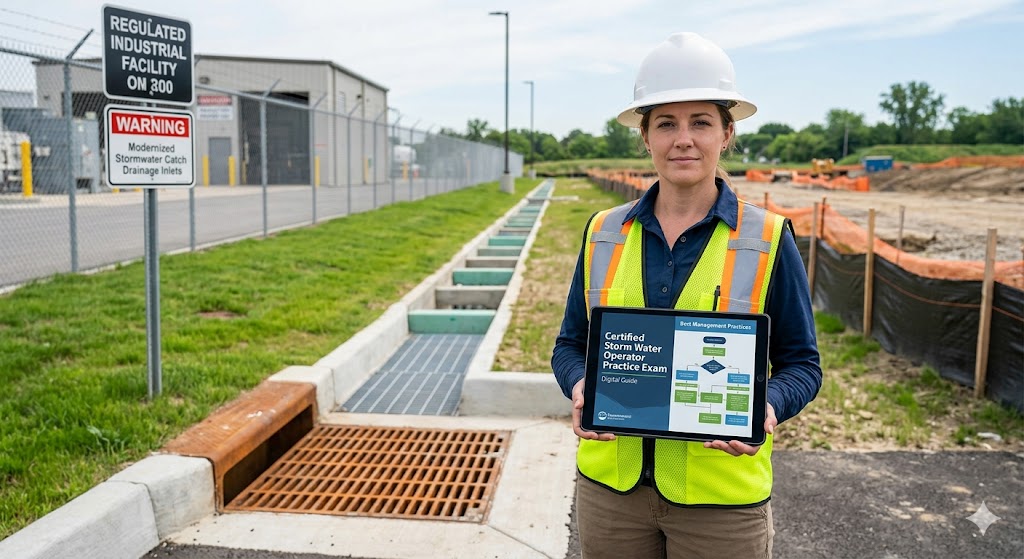
Certified Storm Water Operator Practice Exam
Looking for More?
Check out our comprehensive package plans for ultimate prep materials and exams!
View All PackagesDescription
The Certified Storm Water Operator designation is a
professional credential designed to validate an individual’s knowledge and
competence in managing stormwater runoff. This certification is essential for
personnel responsible for ensuring compliance with state and federal
environmental regulations concerning water quality. It is primarily designed
for construction site managers, municipal employees (especially those working
within Municipal Separate Storm Sewer Systems, or MS4s), industrial facility managers,
and environmental consultants who must implement and oversee erosion control
and pollution prevention plans.
Ready to test your knowledge?
Start nowAbout this Quiz
What the Course
Entails and Exam Details
Preparing for the Certified Storm Water Operator exam
requires a deep understanding of environmental stewardship and regulatory
frameworks. The preparatory course typically focuses on the fundamentals of the
National Pollutant Discharge Elimination System (NPDES) permits.
Operators are trained to identify potential pollution
sources and to select, install, and maintain appropriate Best Management
Practices (BMPs). The core curriculum encompasses diverse topics, including the
hydrology of stormwater runoff, site erosion control techniques, sediment
control, good housekeeping practices, and spill prevention. A significant
portion of the training is dedicated to the proper development and
implementation of Storm Water Pollution Prevention Plans (SWPPPs) and the
methodology for conducting mandatory site inspections and sampling.
What to Expect in
the Final Exam
While specific parameters can vary slightly by state or
certifying body, candidates can generally expect a standardized,
multiple-choice examination. The exam is designed to test both theoretical
knowledge and practical application, sometimes including scenario-based
questions where the candidate must analyze a site map or situation to identify
compliance issues.
The passing score is typically set between 70% and 80%,
depending on the specific jurisdiction. Most exams have a time limit ranging
from one to three hours. Candidates are strictly forbidden from accessing
external resources, such as phones, the internet, or personal notes, during the
test session to ensure the integrity of the certification.
How to Study and
Exam Centers
Effective preparation is the key to success. Students should
begin by thoroughly reviewing the official study guide provided by their state
environmental agency or authorizing body.
The most effective strategy is to utilize a Certified
Storm Water Operator Practice Exam repeatedly to familiarize yourself with
the question format, identify knowledge gaps, and improve your time management
skills. Creating flashcards for regulatory terms, NPDES requirements, and types
of BMPs is highly recommended. For the logistical aspects, you must check the
specific requirements of your state’s environmental department.
Exams are administered through various methods, including
secure online proctored portals, authorized state agency testing facilities, or
third-party professional testing centers such as Pearson VUE, depending on the
current regional regulations.
Job Opportunities
from the Course
Obtaining this certification unlocks significant career
opportunities within the environmental and construction sectors. Employers
frequently require or highly value this designation for roles focused on
regulatory compliance. Specific job titles and career paths available to
certified operators include:
- Stormwater
Inspector
- Erosion
and Sediment Control Specialist
- MS4
Coordinator
- Environmental
Compliance Officer
- Site
Superintendent or Construction Manager
- Industrial
Facility Environmental Manager
- Environmental
Consultant or Technician
- Water
Quality Specialist
Frequently Asked Questions
Reviews
5.0
Based on 0 reviews
Leave a Review
No reviews yet. Be the first to review!
Looking for More?
Check out our comprehensive package plans for ultimate prep materials and exams!
View All Packages