
Certified Recovery Specialist (CRS) Practice Test
Looking for More?
Check out our comprehensive package plans for ultimate prep materials and exams!
View All PackagesDescription
The Certified Recovery Specialist (CRS) is a pivotal
certification designed for individuals who have stabilized their own recovery
from substance use disorders and wish to use their lived experience to mentor,
guide, and support others seeking long-term recovery.
This certification is intended for peers who possess a deep
understanding of the recovery process and are dedicated to helping others
navigate challenges, build resilience, and establish a meaningful life in
recovery.
As a non-clinical role, a CRS focuses on peer support,
empowerment, and resource connection rather than traditional therapy, playing
an essential part in the continuum of care and community integration for those
they serve.
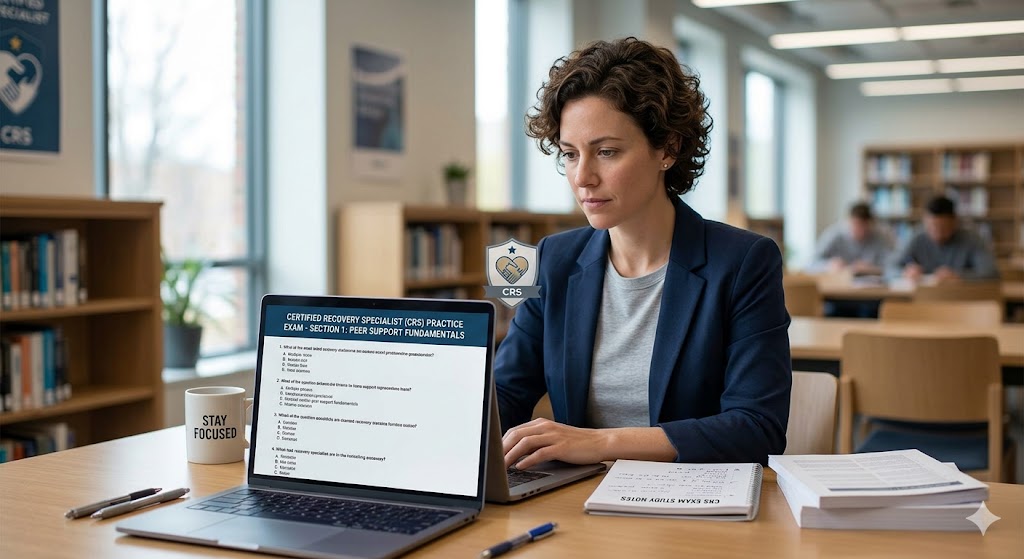
Ready to test your knowledge?
Start nowAbout this Quiz
What the Course Entails and Exam Details
While specific curricula and total required hours vary by
state or authorizing body, standard CRS training courses generally focus on
core philosophies of peer support and recovery-oriented systems of care.
Students will delve into ethics and professional boundaries
specific to the peer role, ensuring a clear distinction from clinical
functions.
The training covers critical communication skills, including
motivational interviewing and active listening, as well as cultural competency
to support diverse individuals in a respectful manner.
Strategies for resource linkage and navigation of
healthcare, social services, and community-based resources are fundamental.
Candidates learn to develop wellness and self-care plans,
essential for maintaining their own stable recovery while serving others.
Standard components also include training in basic crisis
intervention, documentation practices, and wellness-focused mentorship.
The curriculum often requires a mandatory number of
supervised field experience hours, alongside classroom or online learning
modules, to ensure the practical application of these skills.
What to Expect in
the Final Exam
The final CRS exam usually takes the form of a computerized,
multiple-choice assessment administered by the specific state’s credentialing
board, behavioral health division, or an authorized testing service.
The exact number of questions can range from 75 to 150,
covering the key domains outlined in the training course, such as advocacy,
recovery support, ethics, and health and wellness.
The time limit is typically generous, often allowing between
two to three hours for completion.
Candidates must achieve a passing score, which is commonly
set around 70% to 75%, to demonstrate proficiency and earn their certification.
The questions are designed to test both foundational
knowledge and the practical application of CRS principles in real-world
scenarios, and might include scenario-based questions.
Standard testing center rules regarding valid photo
identification, security protocols, and prohibiting personal items during the
test will apply.
How to Study and
Exam Centers
Effective preparation for the CRS exam requires a
multi-faceted approach.
Start by thoroughly studying all provided course materials,
training manuals, and supplementary reading.
Focus heavily on understanding the core ethical principles
and boundary issues unique to the peer support role, as this is a heavily
weighted area.
Utilize practice exams and sample questions, if available
from your certifying body, to become familiar with the multiple-choice format
and to identify areas where you need further review.
Form study groups with fellow students to discuss complex
topics and practice scenario-based decision-making.
Seek mentorship from an existing Certified Recovery
Specialist for practical insights and advice.
Regarding the exam location: The Certified Recovery
Specialist exam is typically administered either through secured online
proctoring portals or at specific physical testing centers designated by your
state's credentialing board or authorizing entity.
These centers might be part of established testing networks
like Pearson VUE or located at authorized community colleges or approved
training providers.
You must register for the exam through the appropriate state
or regional certification board, which will provide you with the most current
list of available testing locations, scheduling procedures, and full testing
details.
Job Opportunities
from the Course
A Certified Recovery Specialist (CRS) certification unlocks
a wide range of job opportunities in the health and social services sectors.
Some of the most common job titles and career paths
available include:
- Certified
Recovery Specialist (CRS)
- Peer
Support Specialist (PSS)
- Recovery
Coach
- Peer
Navigator
- Community
Health Worker (CHW)
- Residential
Support Staff (for recovery or halfway houses)
- Substance
Abuse Counselor Assistant (in some jurisdictions, as an entry point)
- Outreach
Coordinator for recovery-focused organizations
- Recovery
Center Staff and Volunteer Coordinator
Frequently Asked Questions
Reviews
5.0
Based on 0 reviews
Leave a Review
No reviews yet. Be the first to review!
Looking for More?
Check out our comprehensive package plans for ultimate prep materials and exams!
View All Packages