
Certified Pulmonary Function Technologist (CPFT) Practice Exam
Looking for More?
Check out our comprehensive package plans for ultimate prep materials and exams!
View All PackagesDescription
The Certified Pulmonary Function Technologist (CPFT)
credential represents a pinnacle of achievement for respiratory care
practitioners who specialize in diagnostic lung testing. Awarded by the
National Board for Respiratory Care (NBRC), this certification validates a
healthcare professional's advanced knowledge and clinical expertise in
measuring lung function, a critical component in diagnosing and managing
respiratory diseases like asthma, COPD, and cystic fibrosis. This specialty
exam is specifically designed for Registered Respiratory Therapists (RRTs) and
Certified Respiratory Therapists (CRTs) who are committed to advancing their
careers within pulmonary laboratories, diagnostic centers, or acute care
hospitals. Earning the CPFT credential provides a competitive advantage,
demonstrating your dedication to precision and excellence in patient care.
Ready to test your knowledge?
Start nowAbout this Quiz
What the Course Entails and Exam Details
Preparing for the CPFT exam requires a thorough
understanding of the technical and clinical aspects of pulmonary function
testing. The exam curriculum is structured around the official NBRC content
outline, ensuring it covers the exact skills demanded in modern pulmonary labs.
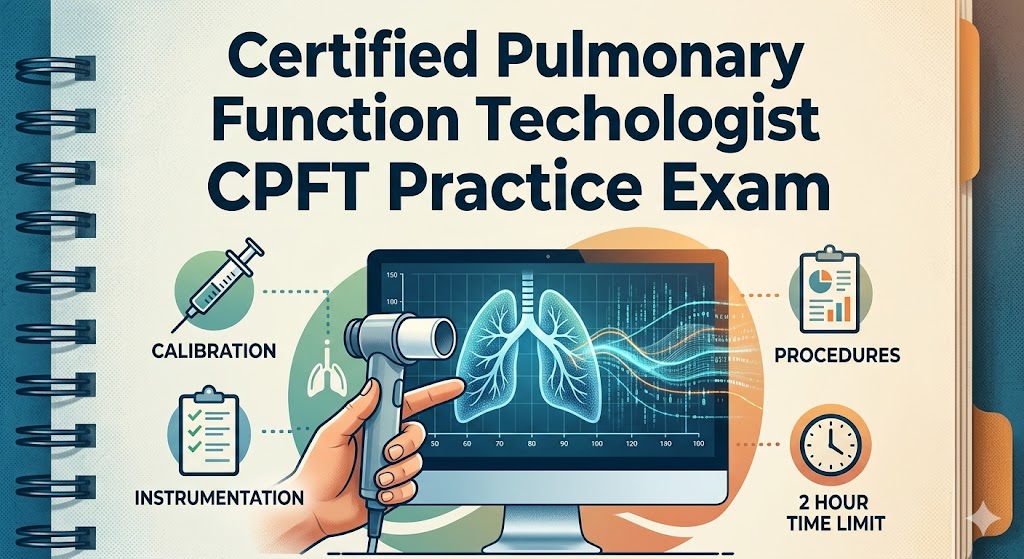
The key areas you must master include the complete instrumentation and
equipment lifecycle, from setup and daily calibration to quality control and
troubleshooting complex diagnostic devices. A significant portion of your
preparation will focus on essential diagnostic procedures, including
spirometry, lung volume determination, diffusion capacity (DLCO), and
bronchoprovocation testing. Candidates must also excel in data management,
learning to accurately record, analyze, interpret, and report patient test
results to physicians, ensuring the highest standards of diagnostic accuracy.
What to Expect in
the Final Exam
The actual CPFT examination is a comprehensive,
computer-based assessment designed to test your knowledge through 115
multiple-choice questions. It is important to know that of these, 100 are
scored questions that determine your final grade, while 15 are unscored
"pretest" items used by the NBRC for future exam development. You
will be allotted a total of 2 hours to complete the test, demanding efficient
time management. The questions evaluate your abilities across three cognitive
levels: the direct recall of facts, the application of knowledge to clinical
scenarios, and the analysis of complex data to make diagnostic recommendations.
To achieve the CPFT credential, candidates must achieve a minimum cut score of
75, which reflects the passing standard established by the NBRC. No outside
materials are permitted, but testing centers will provide a calculator, pencil,
and scratch paper.
How to Study and
Exam Centers
Achieving success on the CPFT exam requires a strategic,
multi-faceted study plan. Begin your preparation by obtaining the official NBRC
CPFT Content Outline to use as your foundational checklist. We highly recommend
integrating our CPFT Practice Exams into your study routine; these simulate the
actual testing environment, help you identify knowledge gaps, and familiarize
you with the three cognitive levels of questions you will encounter. Complement
your practice with specialized review books and respiratory care textbooks
focusing on pulmonary diagnostics. For registration, applicants must apply
online through the official NBRC website, where they can submit their
credentials and pay the required fee. Once your application is approved, you
can schedule your exam at one of approximately 300 PSI testing centers located
across the United States and internationally. For maximum convenience, the NBRC
also offers a Live Remote Proctoring (LRP) option, allowing qualified
candidates to take the exam securely from their own homes or offices.
Job Opportunities
from the Course
Earning the CPFT certification opens doors to specialized
roles and career advancement within the field of respiratory diagnostics. This
credential is widely recognized by employers as a mark of specialty competence,
making you a preferred candidate for key positions in various healthcare
settings. Your expertise will be in high demand in dedicated pulmonary function
laboratories, outpatient pulmonology clinics, acute care hospital systems, and
respiratory research institutions. Some of the specific job titles and career
paths available to a Certified Pulmonary Function Technologist include working
as a specialized Pulmonary Function Technologist, a Lead PFT Technologist
responsible for lab quality, a Clinical Research Coordinator focusing on lung
studies, or an Occupational Health Lung Function Specialist. Achieving this
certification not only validates your clinical skill set but also significantly
enhances your earning potential and professional standing within the allied
health community.
Frequently Asked Questions
Reviews
5.0
Based on 0 reviews
Leave a Review
No reviews yet. Be the first to review!
Looking for More?
Check out our comprehensive package plans for ultimate prep materials and exams!
View All Packages