
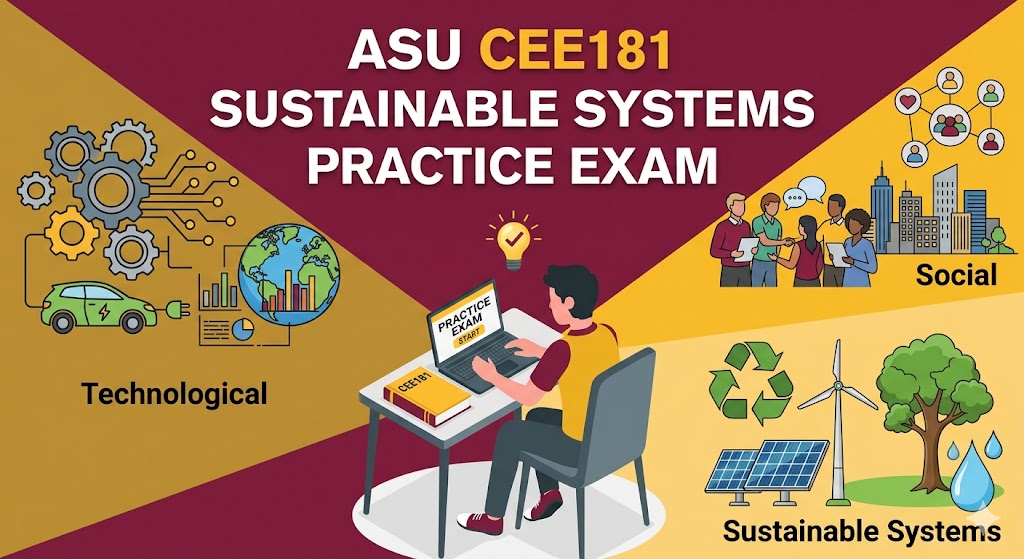
ASU CEE181 Sustainable Systems Practice Exam
Looking for More?
Check out our comprehensive package plans for ultimate prep materials and exams!
View All PackagesDescription
The Arizona State University (ASU) CEE181 Technological,
Social, and Sustainable Systems course is a foundational program designed to
provide students with a holistic understanding of how human-made technological
systems interact with societal structures and the natural environment.
This exam is designed for students enrolled in the course,
particularly those pursuing degrees in engineering, sustainability,
environmental science, and urban planning.
It serves as a critical gateway for demonstrating your ability
to synthesize complex concepts regarding the Anthropocene, industrial ecology,
and the ethical dimensions of emerging technologies.
If you are looking to validate your understanding of how
current decisions impact future global resilience, excelling in this final
assessment is essential.
Ready to test your knowledge?
Start nowAbout this Quiz
What the Course Entails and Exam Details
CEE181 Technological, Social, and Sustainable Systems
explores the co-evolution of technology, society, and the biosphere.
The core syllabus requires students to analyze the long-term
sustainability of various systems from a critical perspective.
Key topics covered include principles of complexity and
complex adaptive systems, the history and future of the Industrial Revolution,
and the implications of the "Anthropocene" era.
Students learn to apply industrial ecology frameworks and
life cycle assessments (LCA) to technological products and infrastructure.
The curriculum also probes the social, cultural,
philosophical, and religious issues associated with emerging technologies at urban,
national, and global scales.
The final exam serves as a comprehensive evaluation of this
material, demanding not just memorization but high-level application of
theoretical concepts to real-world scenarios.
What to Expect in the Final Exam
While the exact structure of the final exam can vary by
instructor, it is typically a proctored, comprehensive assessment taken within
a strict time limit, usually ranging from 110 to 120 minutes.
The format predominantly consists of multiple-choice,
true/false, and matching questions designed to test both foundational knowledge
and analytical skills.
Expect scenario-based questions where you must identify
appropriate sustainable practices or analyze the societal impact of a
hypothetical technological deployment.
There may also be short answer questions requiring you to
define critical terms like "geological engineering,"
"technological momentum," or "sustainable development
goals."
A passing score generally aligns with ASU’s standard grading
policies for credit eligibility, often requiring at least a 70% (C grade) to be
considered satisfactory, depending on whether you are taking the course for
credit eligibility in a pathway program or as a standard enrolled student.
How to Study and Exam Centers
Effective preparation for the CEE181 final requires a
strategic approach.
Start by thorough reviewing all course lectures, discussion
prompts, and content mastery exercises provided within the ASU learning
management system (Canvas).
Pay close attention to historical case studies used in class
to illustrate the social and environmental implications of technological
choices.
Frequently Asked Questions
Reviews
5.0
Based on 0 reviews
Leave a Review
No reviews yet. Be the first to review!
Looking for More?
Check out our comprehensive package plans for ultimate prep materials and exams!
View All Packages