
Associate Certified Electronic Technician Practice Exam
About this Exam
The Associate Certified Electronic Technician (CETa) certification serves as the foundational milestone for individuals aspiring to launch a career in the dynamic field of electronics.
Administered by ETA International, this certification validates a technician's grasp of basic electronics theory and practical core competencies.
It is specifically designed for entry-level technicians, students completing electronics programs, and professionals transitioning into electronic repair and maintenance roles.
Possessing a CETa certification demonstrates to potential employers that you understand the fundamental principles required to succeed in high-tech environments.
It acts as a critical credential to bridge the gap between classroom learning and real-world application, proving your readiness for employment.
Ready to test your knowledge?
Start now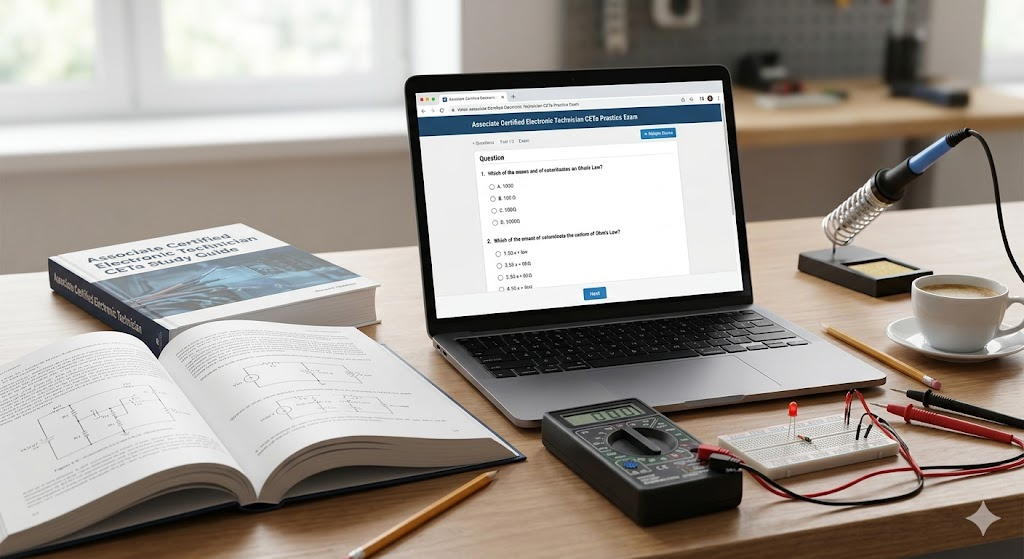
Additional Information
What the Course Entails and Exam Details
Preparing for the CETa certification involves mastering the core syllabus defined by ETA International, which covers the essential concepts of electronics.
The course curriculum typically involves a deep dive into active and passive electronic components and their functions within a circuit.
You will learn fundamental safety procedures, proper use of test equipment like multimeters and oscilloscopes, and standardized soldering techniques.
A significant portion of the syllabus focuses on basic AC and DC circuit theory, Ohm's Law, Kirchhoff's Laws, and troubleshooting methodologies.
Mastery of these foundational skills ensures that you can understand, maintain, and repair a wide range of basic electronic devices and systems.
What to Expect in the Final Exam
The actual CETa exam is a robust assessment designed to test both theoretical knowledge and practical understanding through written questions.
Candidates can expect a computer-based examination typically consisting of 75 to 100 multiple-choice questions.
You will generally have a specific time limit to complete the test, often ranging from 90 minutes to two hours depending on the specific administration rules.
A passing score, often set around 75%, is required to obtain the certification.
The exam focuses purely on theory and requires quick recall of electronic symbols, component identification, and simple mathematical calculations.
It is critical to note that the CETa itself is often a prerequisite before attempting higher-level journeyman specialized certifications.
How to Study and Exam Centers
Effective preparation for the CETa exam requires a blend of studying approved materials and practicing with realistic test questions.
The most valuable study strategy is utilizing a CETa practice exam, which familiarizes you with the question formatting and the pace required for success.
Focus your efforts on reviewing official ETA study guides and textbooks, creating flashcards for symbols and components, and reworking circuit problems until they become intuitive.
Participating in accredited electronics training programs at community colleges or technical schools provides the hands-on lab experience needed to reinforce theoretical knowledge.
When you are ready to test, exams are typically administered through authorized ETA Certification Administrators (CAs).
Testing usually takes place at approved educational institutions, specific Pearson VUE testing centers, or other proctored locations. Some organizations also offer options for online proctoring for greater convenience.
Job Opportunities from the Course
Earning the CETa certification unlocks various entry-level job opportunities across multiple industries reliant on electronic systems.
Common job titles for those holding this credential include:
Bench Electronics Technician
Field Service Technician
Manufacturing Technician supporting production lines
Electronics Assembler
Test and Repair Technician
Maintenance Technician for facility electronic systems
Robotics Operator or Entry-Level Robotics Technician
Telecommunications Equipment Installer
A CETa certification provides the proven foundation necessary to excel in these roles and acts as the first step toward advanced, specialized electronics careers.
Frequently Asked Questions
Reviews
5.0
Based on 0 reviews
Leave a Review
No reviews yet. Be the first to review!