
Army Mountain Warfare School Practice Test
About this Exam
The U.S. Army Mountain Warfare School (AMWS) offers some of the most specialized, grueling, and vital training in the military, designed to transform ordinary Soldiers into lethal, mobile "Mountain Warriors." This school isn't just about climbing; it teaches warfighters how to dominate in inhospitable, high-altitude, and restricted terrain under all climatic conditions. While predominantly attended by Infantrymen, it is open to all Military Occupational Specialties (MOS) from all services who are required to operate, support, or lead units in mountainous environments. Graduation from the Basic Military Mountaineer Course awards the coveted SQI "E" ("Military Mountaineer") additional skill identifier, marking you as a subject matter expert in your unit.
Ready to test your knowledge?
Login please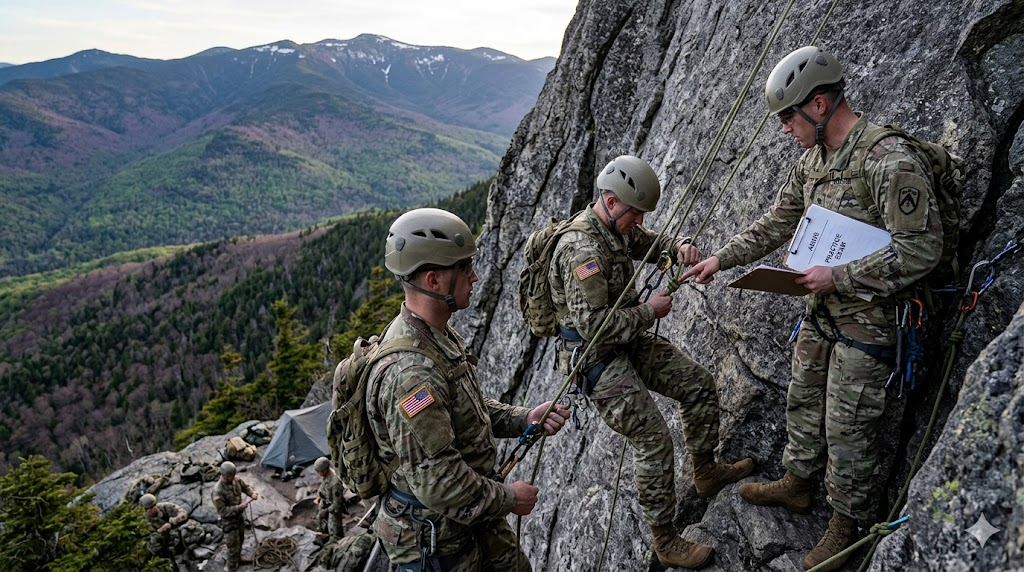
Additional Information
What the Course Entails and Exam Details
The core of the Army Mountain Warfare School is the two-week Basic Military Mountaineer Course (BMMC). This intense program covers a comprehensive range of technical skills across several domains. The syllabus is heavily weighted toward practical application in a rugged field environment at Camp Ethan Allen Training Site in Jericho, Vermont, or through Mobile Training Teams worldwide. Key topics include:
Mountain Travel Techniques: Master movement across Class 1 through 5 terrain, focusing on balance, rest steps, and pressure breathing at altitude.
Vertical Obstacle Negotiation: Extensive instruction on knot tying, rope coiling, belaying, descending (rappelling), and basic ascending techniques on both rock (summer) and ice/snow (winter).
Small Unit Tactics & Navigation: Learn specialized map reading, land navigation using altimeters, and terrain exploitation unique to mountainous corridors.
Military Mountain Medical: Critical skills for caring for and evacuating casualties over difficult terrain under austere conditions, emphasizing high-altitude sicknesses (AMS, HACE, HAPE).
Load Management: Understand the physical toll of mountainous terrain and how to maximize mobility while carrying necessary gear (often rucksacks weighing 45-65 pounds).
Environmental Factors & Weapons: Training on how extreme cold, altitude, and rugged terrain affect weapons maintenance, lethality, and ballistics.
What to Expect in the Final Exam
The final assessment at the Army Mountain Warfare School is a comprehensive evaluation designed to test a student's technical knowledge, physical resilience, and practical mastery. It is not a singular "written test" but a battery of assessments. While specific procedures can evolve, candidates must generally succeed in:
The Written Examination: Expect a multiple-choice exam focusing on theory, safety protocols, medical signs and treatments, knot characteristics, navigation formulas, and environmental awareness. Students must often score 80% or higher to pass this component.
Practical Skills Testing: This is the most critical part. Students are evaluated on their ability to tie specific knots correctly under time pressure, build secure anchor systems, construct safe hauling and evacuation systems, and perform rappelling and climbing techniques while maintaining 100% tie-off and safety. Any critical safety failure is often an automatic dismissal.
Physical Evaluation: Throughout the course, students are continuously assessed on their ability to ruck-march with a standard load over significant elevation gains, typically moving 4-6 miles a day over severe terrain.
Graduation Requirements: To earn the Ram’s Head device and the SQI "E," you must pass all written modules, demonstrate 100% proficiency in practical evaluations, and complete all required field exercises.
How to Study and Exam Centers
Preparation is paramount, as failure rates can be high due to the technical complexity and physical demands. Follow this strategy:
Actionable Study Strategies
Memorize Knots Immediatley: Obtain a length of climbing rope and the AMWS Student Handout well before your slot. Master every knot mentioned (Figure-Eight series, Clove Hitch, Bowline, Alpine Butterfly, etc.) until you can tie them quickly, correctly, and blindfolded. This is where most students fail.
Get into "Ruck-Shape": Do not rely on standard PT. Practice rucking 4-6 miles over hilly terrain with a 45-50 pound load. Break in your boots months in advance to prevent blisters.
Review Medical/Nav Theory: Study the AMWS manual. Familiarize yourself with the signs and treatments for Hypothermia, Frostbite, AMS, HACE, HAPE, and the nuances of altimeter navigation.
Leverage Practice Tests: Utilize digital resources, flashcards, or quizlet sets based on AMWS manual questions (similar to the practice test structure) to reinforce theoretical knowledge.
Where to Take the Exam
The "final exam" is the course itself. You cannot challenge the exam without attending the schoolhouse. Slots for the Army Mountain Warfare School must be secured through your unit’s training NCO via the Army Training Requirements and Resources System (ATTRS). The primary testing facility is the Camp Ethan Allen Training Site in Jericho, Vermont.
Job Opportunities from the Course
Graduating from the Army Mountain Warfare School unlocks specific career paths within the U.S. Army by certifying you as a specialist in restricted terrain operations. The SQI "E" and associated identifiers make you a highly valued asset for specialized assignments.
SQI "E" (Military Mountaineer) for Enlisted Personnel: You will be designated as the unit's mountain operations expert, responsible for advising leadership and training fellow Soldiers.
ASI A4 for Warrant Officers & Officers: Marks you as qualified to lead and plan operations in mountainous and restricted terrain.
Special Operations Forces (SOF) Roles: AMWS graduation is often a prerequisite or highly desired qualification for assignments within Special Forces Groups, the 75th Ranger Regiment, or other specialized units operating in rugged areas like Afghanistan or the Andes.
Mountain Infantry Leader/Instructor: Opportunities to lead specialized mountain platoons or serve as an instructor back at AMWS or within the Vermont National Guard.
Search and Rescue Team Member: Qualified to serve on technical high-angle mountain search and rescue teams within appropriate units.
Mountain Planner: Prepares you for advanced roles planning operations in arctic, sub-arctic, and high-altitude regions.
High-Angle Marksmanship Specialist: (Upon completion of the Mountain Rifleman Course) Advanced sniper or squad-designated marksman roles in alpine environments.
Frequently Asked Questions
Reviews
5.0
Based on 0 reviews
Leave a Review
No reviews yet. Be the first to review!