
Army EO/SHARP Board Practice Test
About this Exam
The Army Equal Opportunity (EO) and Sexual Harassment/Assault Response and Prevention (SHARP) programs are cornerstones of military readiness and professional conduct. The Army EO/SHARP Board is not a single computerized exam; rather, it is a critical knowledge evaluation, often integrated into promotion boards (e.g., for promotion to Sergeant or Staff Sergeant) or specific certification pathways for program advisors. This evaluation is designed for all Soldiers, but particularly for non-commissioned officers (NCOs) and those seeking to become Equal Opportunity Leaders (EOLs), Unit Victim Advocates (UVAs), or specialized advisors. It ensures that leaders possess the essential regulatory knowledge, situational judgment, and dedication to maintaining a command climate built on dignity, respect, and safety. Mastering this material demonstrates that a Soldier is ready to enforce Army policy and care for their team.
Ready to test your knowledge?
Start now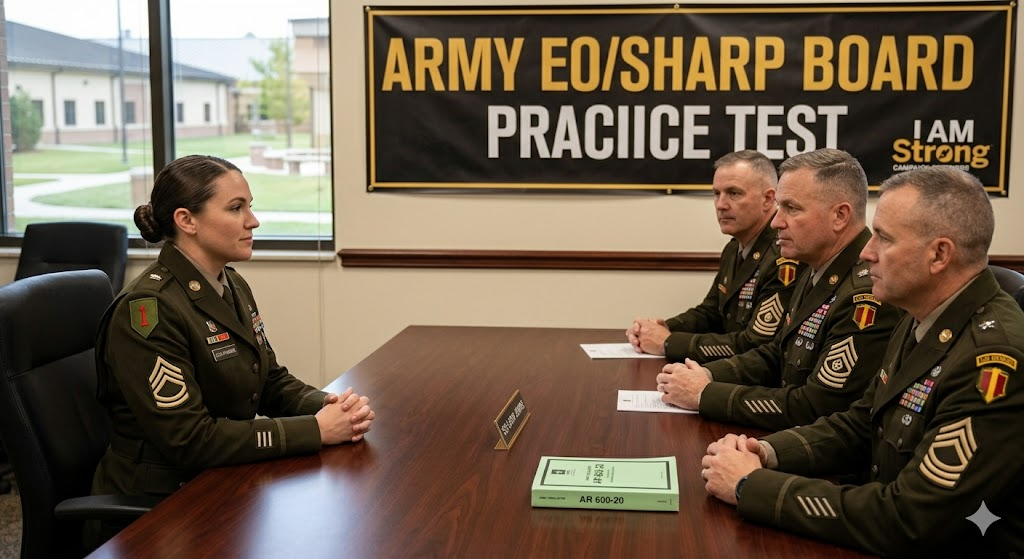
Additional Information
What the Course Entails and Exam Details
Preparation for an Army EO/SHARP Board requires a thorough understanding of current regulations and doctrinal philosophies. The core curriculum centers on Department of the Army Pamphlet 600-20 (Army Command Policy), specifically Chapter 6 (Equal Opportunity Program) and Chapters 7 & 8 (SHARP Program).
The study material covers vital areas, including:
EO Definitions and Policies: Mastering the precise definitions of discrimination, the six bases of discrimination (race, color, sex (including gender identity and sexual orientation), religion, national origin, and disability), and the purpose of the EO program.
EO Complaint Processes: Understanding the difference between informal and formal complaints, the channels through which a Soldier can file, the required DA Form 7279, and the strict timelines for processing.
SHARP Definitions and Campaign: Reciting the "I AM Strong" slogan and its meaning (Intervene, Act, Motivate), and differentiating between sexual harassment (verbal, non-verbal, physical) and sexual assault (a criminal offense).
Sexual Harassment Prevention and Techniques: Knowing the five techniques for dealing with sexual harassment (direct, indirect, third-party, chain of command, and formal complaint).
SHARP Reporting Options: Confidently explaining the critical differences between Restricted and Unrestricted reporting, who can receive a restricted report (SARC, VA, Chaplain, Healthcare Provider), and the role of DD Form 2910.
Roles and Responsibilities: Detailing the functions of the EOA (Advisor), EOL (Leader), SARC (Coordinator), and UVA (Advocate), as well as the overarching responsibilities of commanders in managing command climate.
What to Expect in the Final Exam
The "exam" in this context is almost always an oral evaluation conducted by a panel of senior non-commissioned officers and officers. This board appearance is standardized in structure but subjective in scoring. Soldiers should expect the following format:
Oral Examination: The candidate will sit before the board and be asked a series of direct and situational questions.
Situational Scenario Questions: A significant portion of the modern board focuses on how you apply policy to real-world leadership challenges. Example: "You are a squad leader and your Soldier comes to you and says another Soldier is mocking their accent. What actions do you take?"
Verbatim Knowledge Requirements: Some questions will require precise, textbook definitions of terms like "sexual assault" or "quid pro quo harassment."
Passing Score: There is no numerical passing score in an oral board. Success is determined by the candidate's confidence, military bearing, the accuracy and completeness of their answers, and their ability to articulate a sound leadership philosophy based on Army values.
Time Limits and Atmosphere: While the board appearance itself has a definitive start and end time (usually 20 to 45 minutes), the environment is formal and high-pressure.
How to Study and Exam Centers
Preparation for an oral board differs significantly from studying for a written test. The most effective study strategies are active and collaborative:
Practice Mock Boards: This is the absolute best way to prepare. Have your peers or mentors act as board members and ask you a mix of definition and scenario-based EO/SHARP questions. Practice your entry, your posture, and stating "I do not know the answer at this time, but I will find out and report back to you."
Focus on Verbatim Definitions: Flashcards (using platforms like Quizlet or physical cards) are excellent for memorizing crucial definitions from AR 600-20.
Analyze Regulatory Updates: Ensure you are studying the current version of AR 600-20, as policies on reporting options and protected categories can evolve.
Utilize Study Guides and Portals: Units often maintain internal study guides. Online practice tests are resources to help you identify knowledge gaps, but they are not the final evaluation.
Where and How to Take the Board:
The board is a unit-level event. Your Chain of Command will notify you of your board date and time. It takes place in a formal board room within your battalion, brigade, or installation headquarters, not at a civilian center like Pearson VUE.
Job Opportunities from the Course
While the EO/SHARP Board itself is an evaluation, mastery of the information tested is a requirement for several critical career fields and additional duties within the Army:
Equal Opportunity Leader (EOL) – Additional Duty
Unit Victim Advocate (UVA) – Additional Duty
Equal Opportunity Advisor (EOA) – Primary MOS/Billet
Sexual Assault Response Coordinator (SARC) – Primary MOS/Billet
NCO Professional Development (all leadership roles)
Command Climate Specialist
Frequently Asked Questions
Reviews
5.0
Based on 0 reviews
Leave a Review
No reviews yet. Be the first to review!