
Armor Basic Officer Leader Course (ABOLC) Doctrine Practice Test
About this Exam
The Armor Basic Officer Leader Course (ABOLC) Doctrine Practice Test is a critical initial evaluation designed for newly commissioned Second Lieutenants in the US Army who have branched into the Armor Corps.
This exam is designed to validate a junior officer’s foundational knowledge of Army and Armor-specific doctrine before they advance to complex tactical and technical field training.
Passing this test demonstrates that the officer understands the core principles, terminology, and tactical operational patterns required to lead an Armor or Cavalry platoon effectively.
Ready to test your knowledge?
Start now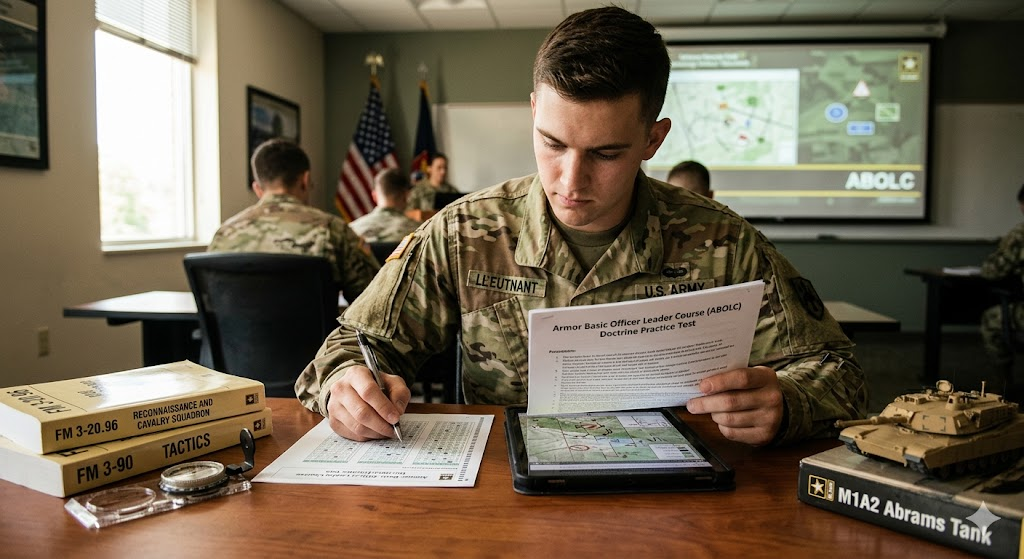
Additional Information
What the Course Entails and Exam Details
ABOLC is a rigorous, multi-phased course that transforms basic officers into competent Armor leaders. The operational doctrine segment focuses heavily on classroom instruction covering the establishment of foundational tactical knowledge.
Core topics included in the doctrine syllabus are:
Foundational Army Doctrine: Understanding Unified Land Operations (ULO), the warfighting functions, and operational terms and graphics.
The Armor Platoon: The organization, capabilities, and limitations of M1 Abrams and M2 Bradley sections, and Cavalry Scout platoons.
Offensive Operations: Movement to contact, attack (hasty and deliberate), exploitation, and pursuit at the platoon and company team level.
Defensive Operations: Area defense, mobile defense, and retrograde operations (delay, withdrawal, and retirement).
Reconnaissance and Security (R&S): The fundamentals of reconnaissance (zone, area, route) and security operations (screen, guard, cover).
Troop Leading Procedures (TLPs): The eight-step process for planning and executing tactical missions.
The ABOLC Doctrine Practice Test directly measures comprehension in these critical areas through structured testing.
What to Expect in the Final Exam
The actual ABOLC doctrine evaluation is typically a proctored, closed-book examination administered in a controlled classroom environment. Officers can generally expect the following format:
Format: The exam predominantly consists of multiple-choice questions designed to test knowledge retrieval and scenario-based application. It may also include matching terms, interpreting tactical graphics, and short-answer responses.
Passing Score Requirements: Students are usually required to achieve a minimum score of 80% to pass, although this standard can be subject to change by the command. Failing may require retraining and a retest.
Time Limits: A specific time limit (often 90 to 120 minutes) is strictly enforced, requiring officers to work efficiently through the material.
Specific Rules: No external doctrinal materials, personal notes, or smart devices are allowed during the test. Understanding standard military symbology is required.
How to Study and Exam Centers
Preparation for the ABOLC Doctrine Practice Test requires dedicated study of official Army publications. Here are actionable strategies:
Master the Publications: The primary source materials are Army Regulations (AR), Department of the Army Pamphlets (DA PAM), Field Manuals (FM), and Army Techniques Publications (ATP). Key documents include FM 3-90 (Tactics), ATP 3-20.15 (Tank Platoon), and ATP 3-20.98 (Reconnaissance Platoon).
Use Active Recall: Create flashcards for critical terms, tactical graphics, and the steps of TLPs.
Practice Symbology: Draw and interpret common tactical military symbols until it becomes intuitive.
Scenario-Based Review: Don't just memorize definitions; understand how to apply offensive or defensive principles in a given tactical scenario.
The ABOLC Doctrine Practice Test, and the subsequent official evaluation, are administered exclusively at the U.S. Army Armor School located at Fort Moore (formerly Fort Benning), Georgia. They are not available through external centers like Pearson VUE or standard online portals.
Job Opportunities from the Course
Successfully completing ABOLC and branching as an Armor Officer is the essential gateway to a career in the maneuvering force. This training specifically unlocks primary leadership positions such as:
Armor Platoon Leader (M1 Abrams)
Infantry/Scout Platoon Leader (M2 Bradley)
Cavalry Scout Platoon Leader (Stryker or HMMWV-based)
Company Executive Officer (XO)
Battalion or Brigade Staff Officer (S-3 Operations, S-2 Intelligence, S-4 Logistics)
Troop Commander (after subsequent training and experience)
Cavalry Squadron Staff Officer
Frequently Asked Questions
Reviews
5.0
Based on 0 reviews
Leave a Review
No reviews yet. Be the first to review!