
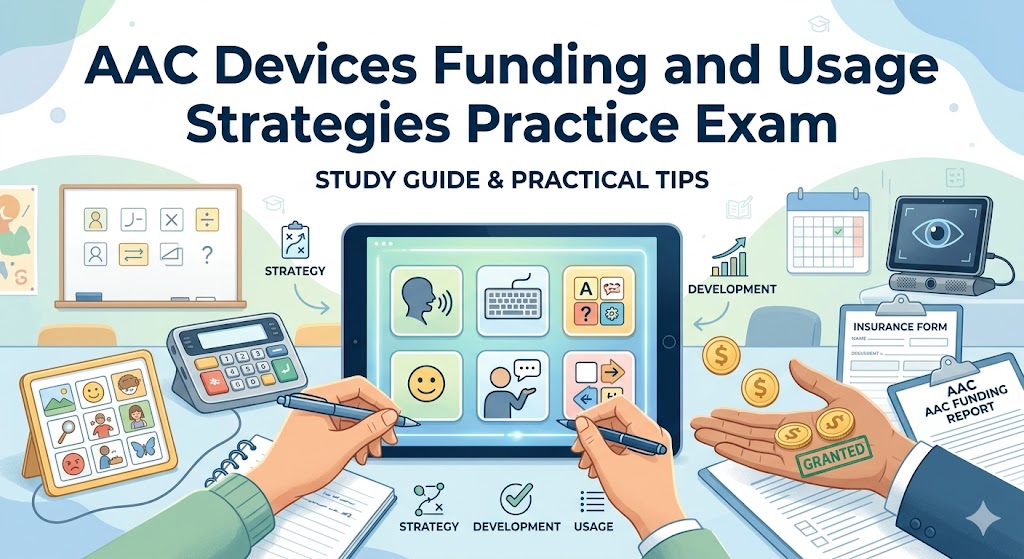
AAC Devices Funding and Usage Strategies Practice Exam
Looking for More?
Check out our comprehensive package plans for ultimate prep materials and exams!
View All PackagesDescription
The AAC Devices – Funding, Development, and Usage
Strategies Practice Test is designed as a crucial preparatory tool for
allied health and educational professionals aiming to master the intricacies of
Augmentative and Alternative Communication (AAC). This exam validates a
candidate’s comprehensive knowledge of the entire AAC lifecycle, moving beyond
clinical assessment to the vital logistics of securing technology and
integrating it effectively into a client’s life. It is specifically tailored
for Speech-Language Pathologists (SLPs), Occupational Therapists (OTs), Special
Education Teachers, and Assistive Technology (AT) Specialists. By successfully
navigating this practice test, candidates demonstrate their readiness for
real-world certification and their ability to advocate effectively for
individuals with complex communication needs.
Ready to test your knowledge?
Start nowAbout this Quiz
What the Course Entails and Exam Details
This comprehensive assessment covers the critical syllabus
areas that bridge the gap between recommending an AAC device and seeing it used
successfully.
The exam content is structured around four primary pillars:
I. Funding Strategies and Documentation
This section tests knowledge of the funding landscape. It
covers identifying viable funding sources including Medicare, Medicaid, private
insurance, and educational grants. Crucially, it assesses the ability to write
a compelling, technically accurate “Speech-Language Pathology Evaluation for
a Speech Generating Device (SGD)†that meets specific insurer criteria for
medical necessity.
II. Device Development and Technology Systems
Candidates are assessed on their understanding of the AAC
technology spectrum. This includes differentiating between low-tech, mid-tech,
and high-tech systems. The exam covers selection criteria based on hardware
(switches, dynamic displays) and software (symbol sets, core vs. fringe
vocabulary, language organization strategies).
III. Evidence-Based Usage Strategies
This pillar focus on implementation. It tests understanding
of various interaction strategies such as Modeling (Aided Language
Stimulation), Core Vocabulary approaches, and engineering communication
environments. It covers training techniques for both the user and their
communication partners.
IV. Ethical and Policy Considerations
The test assesses knowledge of relevant laws, such as the
Americans with Disabilities Act (ADA) and the Individuals with Disabilities
Education Act (IDEA), alongside ethical considerations regarding user autonomy
and cultural competence in device selection.
What to Expect in the Final Exam
While the specific format may vary by the issuing body, this
study guide article simulates a typical professional certification experience.
Exam Format
You should expect a digitally administered exam primarily
composed of 60 to 100 multiple-choice questions.
A significant portion of the test will be scenario-based.
For example, you might be presented with a patient profile (e.g., “A
7-year-old with non-speaking autism funded by Medicaid†) and asked to select
the most appropriate combination of device type, funding justification
strategy, and initial usage modeling technique.
Time Limit
Candidates typically have 90 to 120 minutes to complete the
exam. Time management is crucial, as scenario questions require careful
reading.
Passing Score
A passing score is generally set between 70% and 80%,
depending on the statistical weighting of the specific test form.
How to Study and Exam Centers
Study Strategies
To ensure success on the final exam, adopt a robust and
multifaceted study plan:
Review Official Guidelines: Deeply study ASHA’s
(American Speech-Language-Hearing Association) latest technical reports on AAC
service delivery and funding. These often serve as the basis for test
questions.
Practice Documentation: Do not just read about
funding; practice writing justification letters for fictitious clients. Ensure
you can connect a user’s impairment (e.g., severe dysarthria) to specific
device features (e.g., eye-gaze access) within the language of medical
necessity.
Utilize Flashcards: Create flashcards for key
acronyms (SGD, CCN, NLP), different funding models, and the names of specific
usage techniques (e.g., Backward Chaining).
Take Timed Practice Tests: Repeatedly taking the
practice test will build your mental stamina and help you identify areas where
your knowledge is weakest, particularly concerning insurance reimbursement
codes or device software types.
Exam Centers and Administration
This exam is primarily administered digitally through
accredited portals.
Candidates usually have two options for taking the final
test:
Authorized Testing Centers: These are physical
locations, such as those operated by Pearson VUE or authorized schools and
universities, offering a secure, proctored environment.
Online Proctoring: Many certifying bodies now offer
the convenience of taking the exam from your home or workplace using a personal
computer. This requires a strong internet connection, a webcam, and strict
adherence to environmental proctoring rules.
Job Opportunities from the Course
Earning this certification unlocks numerous specialized
career paths across the health and education sectors. It demonstrates a high
level of specialized competence that distinguishes you from generalist
practitioners.
Potential job opportunities include:
- Augmentative
Communication Specialist (AAC Specialist)
- Speech-Language
Pathologist, AAC Focus (within hospitals, schools, or private
practice)
- Assistive
Technology (AT) Consultant
- AAC
Funding Coordinator (working for device manufacturers or advocacy
organizations)
- Special
Education AAC Coordinator
- AAC
Implementation Coach
- Rehabilitation
Engineering Technologist (focused on communication interfaces)
Frequently Asked Questions
Reviews
5.0
Based on 0 reviews
Leave a Review
No reviews yet. Be the first to review!
Looking for More?
Check out our comprehensive package plans for ultimate prep materials and exams!
View All Packages