
A-100 Basic Aviation Safety Practice Exam
Looking for More?
Check out our comprehensive package plans for ultimate prep materials and exams!
View All PackagesDescription
The A-100 Basic Aviation Safety exam is a critical stepping
stone for anyone wishing to build a career in the aviation industry.
It is designed to validate a comprehensive understanding of
the foundational principles of aviation safety, covering regulations, risk
assessment, and emergency procedures.
This certification is a requirement for many entry-level and
support roles, ensuring that all professionals operating in or around aircraft
have a standardized, robust knowledge of safety protocols.
Whether you aspire to be a pilot, a flight attendant, a
ground technician, or work in a support capacity, this exam demonstrates your
commitment to a safety-first culture.
Ready to test your knowledge?
Start nowAbout this Quiz
What the Course Entails and Exam Details
The A-100 Basic Aviation Safety course provides a structured
deep dive into the practical aspects of staying safe in an aviation
environment.
The curriculum typically covers several core areas:
- Introduction
to Aviation Safety Management Systems (SMS): Understanding the
proactive approach to identifying hazards and managing risk.
- Human
Factors in Aviation: Exploring the psychological and physiological
factors that affect human performance and decision-making.
- Aviation
Regulations and Oversight: Familiarization with the roles of
regulatory bodies like the FAA (Federal Aviation Administration) and ICAO
(International Civil Aviation Organization), and key regulations.
- Pre-Flight
and Post-Flight Safety Procedures: Detailed protocols for aircraft
inspection, fueling safety, and securing aircraft.
- Emergency
Procedures and Response: Comprehensive training on handling in-flight
and ground-based emergencies, including fire safety, medical emergencies,
and evacuation.
- Communication
Protocols: Mastering the standard communication phrases and procedures
used to ensure clarity and avoid errors.
- Risk
and Hazard Assessment: Developing the skills to perform a thorough
aerial hazard analysis and Project Aviation Safety Plan (PASP).
The exam details are structured to test this knowledge
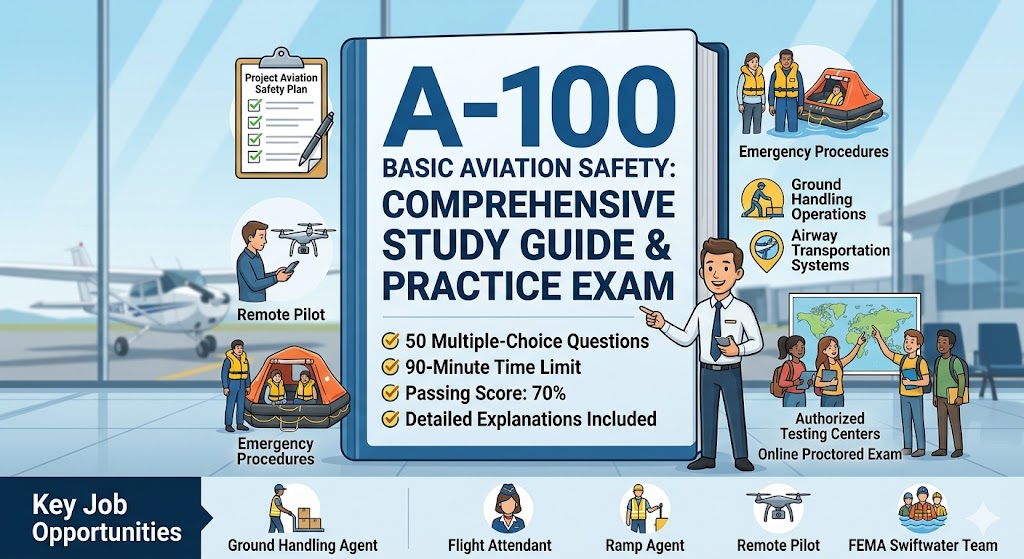
effectively. Candidates can expect 50 multiple-choice questions.
You will have 90 minutes to complete the test. A passing
score of 70% is required, which typically means answering at least 35 questions
correctly.
What to Expect in the Final Exam
When you step into the test, you can expect a computer-based
examination that focuses on practical application of safety knowledge.
The multiple-choice format often presents scenario-based
questions, asking you to identify the correct procedure or regulation in a
given situation. For example, you may be asked the transponder code for a radio
communication failure (7600), or the required contents of a survival kit.
There are no practical, hands-on components to the final A-100
exam itself; the assessment is purely to verify theoretical knowledge.
The final score is often provided immediately upon
completion, giving you instant feedback on your result.
How to Study and Exam Centers
Preparation is the key to success on the A-100 Basic
Aviation Safety exam. A dedicated approach will not only help you pass but will
instill a genuine understanding of safety culture.
Here are actionable strategies to prepare:
- Use
Official Study Guides: Begin with the study materials provided by your
authorized training organization or employer. These are directly aligned
with the exam content.
- Take
Practice Exams: This is one of the most effective ways to assess your
readiness and become familiar with the question format. Use a practice
test repeatedly to identify weak areas.
- Create
Flashcards: Create flashcards for critical information like Q-codes
(e.g., QNH), transponder codes (e.g., 7500 for hijack, 7700 for
emergency), aircraft call signs, and key regulatory terms.
- Review
Real-World Scenarios: Read accident and incident reports from bodies
like the NTSB to understand how human factors and procedural failures
contribute to aviation accidents.
Where to take the exam depends on the context of your
training.
Most commonly, the exam is proctored online or taken at a
designated testing facility. If you are part of a larger organization (e.g., a
FEMA swiftwater team, an airline, or a ground handling company), they will
likely provide the testing platform.
Authorized aviation schools, training centers, and some
physical testing centers, such as Pearson VUE, may also host the exam. Ensure
you check with your specific program coordinator for the correct location or
portal.
Job Opportunities from the Course
Earning the A-100 Basic Aviation Safety certification opens
a multitude of doors within the vast aviation and emergency response sectors.
It is a prerequisite or a highly valued asset for roles such
as:
- Aviation
Safety Assistant
- Ground
Handling Agent
- Aircraft
Dispatcher
- Flight
Attendant
- Ramp
Agent
- Airway
Transportation Systems Specialist
- Airport
Operations Specialist
- FEMA
Swiftwater Team Member (Special Operations)
- Ground
Support Technician
- Flight
Instructor (as a foundational knowledge base)
- Remote
Pilot (UAS Operators)
Frequently Asked Questions
Reviews
5.0
Based on 0 reviews
Leave a Review
No reviews yet. Be the first to review!
Looking for More?
Check out our comprehensive package plans for ultimate prep materials and exams!
View All Packages