
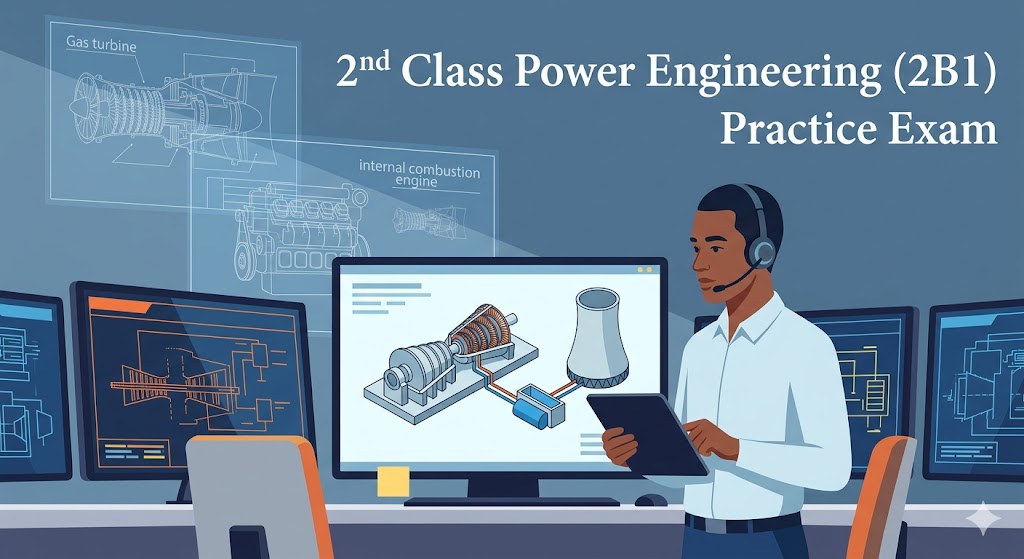
2nd Class Power Engineering (2B1) Practice Exam
Looking for More?
Check out our comprehensive package plans for ultimate prep materials and exams!
View All PackagesDescription
Earning your 2nd Class Power Engineering Certification is a defining moment
that signals your transition from an operator to a senior technical leader.
This certification is designed for ambitious 3rd Class Engineers who have the
prerequisite field experience and are ready to manage, supervise, and take
operational charge of large-scale industrial plants. The 2B1 exam,
specifically, is a critical hurdle in the "Part B" section of the
certification journey, testing your mastery of the complex machinery that forms
the heart of modern power generation and manufacturing.
Passing this exam proves you possess the sophisticated
theoretical knowledge required to oversee the operation, maintenance, and
safety of significant prime movers and their essential auxiliary systems.
Ready to test your knowledge?
Start nowAbout this Quiz
What the Course Entails and Exam Details
The 2nd Class Power Engineering (2B1) exam syllabus is
focused heavily on the mechanics, thermodynamics, and operational control of
prime movers and auxiliary plant systems. While candidates usually prepare
through self-study or standardized courses provided by technical institutes,
the 2B1 exam specifically assesses expertise in the following key areas defined
by SOPEEC (Standardization of Power Engineer Examinations Committee):
<!--[if !supportLists]-->·
<!--[endif]-->Industrial Lubrication: Mastery of friction theory,
lubricant properties, testing methods, and the application of sophisticated
lubrication systems required for high-speed, heavy-duty machinery.
<!--[if !supportLists]-->·
<!--[endif]-->Piping and Drawings: Advanced knowledge of piping
design, materials, advanced steam trapping, water hammer prevention, and the
ability to interpret complex industrial blueprints and P&IDs (Piping and
Instrumentation Diagrams).
<!--[if !supportLists]-->·
<!--[endif]-->Heat Engines and Prime Movers:
<!--[if !supportLists]-->o <!--[endif]-->Steam Turbines: Detailed
understanding of impulse and reaction turbine theory, construction, governor
systems, operational procedures, and efficiency calculations.
<!--[if !supportLists]-->o <!--[endif]-->Internal Combustion Engines:
Expert knowledge of two-cycle and four-cycle diesel and gas engines, fuel
injection systems, scavenging, and engine operation.
<!--[if !supportLists]-->o <!--[endif]-->Gas Turbines:
Comprehensive study of gas turbine cycles (Brayton), design, construction, and
advanced operational controls.
<!--[if !supportLists]-->·
<!--[endif]-->Steam Condensers and Cooling Towers: In-depth
knowledge of condenser types, maintenance, cooling tower design, water
treatment within these systems, and performance efficiency.
What to Expect in the Final Exam
The 2nd Class Power Engineering (2B1) final exam is a
rigorously timed, comprehensive test standardized across many jurisdictions to
ensure interprovincial competency. Candidates must arrive prepared for a
demanding session that focuses purely on objective assessment of technical
knowledge.
You can expect the following structure for the official
examination:
<!--[if !supportLists]-->·
<!--[endif]-->Format: The exam is strictly multiple-choice. There
are no long-answer or essay questions.
<!--[if !supportLists]-->·
<!--[endif]-->Question Count: The paper consists of exactly 100
questions.
<!--[if !supportLists]-->·
<!--[endif]-->Time Limit: Candidates are given a strict three-hour
window (180 minutes) to complete the entire exam. This averages to less than
two minutes per question, requiring decisive, efficient knowledge retrieval.
<!--[if !supportLists]-->·
<!--[endif]-->Passing Score: The minimum required passing grade is
65%. There is no partial credit.
<!--[if !supportLists]-->·
<!--[endif]-->Permitted Materials: Candidates are generally allowed
standard non-programmable calculators and specific code books or reference
supplements allowed by the local regulatory authority.
How to Study and Exam Centers
Preparation for the 2B1 exam must be disciplined and
systematic. Because this is a senior level, simply reading the textbooks is
rarely enough to pass. Your study strategy should emphasize understanding the
"why" behind operational procedures, not just memorizing "how."
Follow these actionable strategies to maximize your
success:
<!--[if !supportLists]-->·
<!--[endif]-->Master the Core Texts: Use the PanGlobal 2nd Class
textbooks as your foundational resource. Create detailed notes, prioritizing
mathematical formulas, diagrams, and efficiency calculations.
<!--[if !supportLists]-->·
<!--[endif]-->Simulate with Practice Exams: This is perhaps the most
critical component. Regularly taking a 2B1 Power Engineering Practice Exam
under timed conditions is essential. This builds required pacing, improves
accuracy under pressure, and exposes weak areas you might have overlooked in
your reading.
<!--[if !supportLists]-->·
<!--[endif]-->Prioritize Weakness over Comfort: Do not spend your
time reviewing topics you already know well. Focus immediately and aggressively
on your hardest areas, whether that is turbine governing systems, gas turbine
thermodynamics, or P&ID interpretation.
The official examination is not taken online from home;
it is administered exclusively by authorized provincial safety authorities or
regulatory bodies. In Canada, this includes organizations such as ABSA
(Alberta), TSSA (Ontario), Technical Safety BC (British Columbia), or TSASK
(Saskatchewan).
Scheduling your exam requires registering through your
specific province's regulatory portal. You must choose a slot at one of their
designated, supervised testing centers, or sometimes through authorized
technical institutes that host the official sitting. Ensure you have confirmed
your eligibility (holding a valid 3rd Class Certificate) before booking your
slot.
Job Opportunities from the Course
A 2nd Class Power Engineering Certification
fundamentally shifts your career trajectory, unlocking senior operational roles
and leadership positions within large, complex industrial facilities. This
qualification is highly sought after by major employers in sectors like power
generation, petrochemicals, pulp and paper, and heavy manufacturing.
Possessing this certificate demonstrates the technical
maturity required for significant responsibilities.
The following represent core career paths and senior
job titles unlocked by this certification:
<!--[if !supportLists]-->·
<!--[endif]-->Chief Power Engineer: Assuming ultimate operational
and regulatory responsibility for entire plants (typically up to Third Class
classification).
<!--[if !supportLists]-->·
<!--[endif]-->Shift Engineer (Second Class Plant): Leading an entire
operations crew and taking charge of massive first- or second-class boilers and
turbines during a specific shift.
<!--[if !supportLists]-->·
<!--[endif]-->Operations Manager: Overseeing broader plant
operations, budgets, personnel management, and long-term maintenance planning.
<!--[if !supportLists]-->·
<!--[endif]-->Maintenance Supervisor: Coordinating specialized
maintenance teams for critical prime mover assets.
<!--[if !supportLists]-->·
<!--[endif]-->Energy Manager or Energy Auditor: Using senior
technical expertise to optimize plant efficiency and reduce operational costs.
<!--[if !supportLists]-->·
<!--[endif]-->Industrial Inspector: Employed by regulatory
authorities or insurance firms to ensure large plant compliance.
Frequently Asked Questions
Reviews
5.0
Based on 0 reviews
Leave a Review
No reviews yet. Be the first to review!
Looking for More?
Check out our comprehensive package plans for ultimate prep materials and exams!
View All Packages