
2nd Class Power Engineering 2A2 Practice Exam Guide
Looking for More?
Check out our comprehensive package plans for ultimate prep materials and exams!
View All PackagesDescription
The 2nd Class Power Engineering certification represents a major leap toward
senior leadership in the energy and industrial sectors. This highly respected
credential is designed for experienced 3rd Class Power Engineers who are ready
to take on significant responsibility. The 2A2 exam specifically targets
advanced technical knowledge, ensuring engineers possess the sophisticated
skills required to oversee complex power plant operations and manage intricate
systems safely and efficiently. Obtaining this certification demonstrates your
dedication to professional mastery and validates your capability to perform
advanced calculations and analyze critical plant dynamics.
Ready to test your knowledge?
Start nowAbout this Quiz
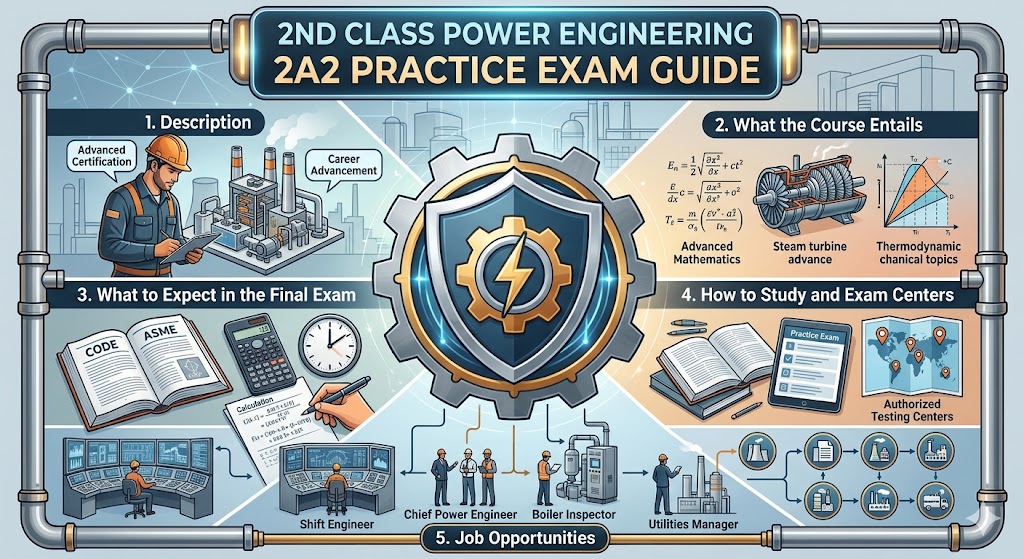
What the Course Entails and Exam Details
Preparing for the 2A2 exam requires a comprehensive
understanding of complex mathematical principles and their practical
application in a power plant setting. The core syllabus covered in this section
of the 2nd Class curriculum focuses on advanced technical theory rather than
basic operations.
You must master topics in advanced applied mechanics,
including statics, dynamics, and strength of materials, which are essential for
evaluating machinery forces and structural integrity. The exam deeply explores
complex thermodynamics, requiring the ability to solve challenging problems
involving steam properties, various gas laws, and the operation of air
compressors and refrigeration cycles. Additionally, you will study advanced
fluid mechanics and advanced combustion principles. This includes analyzing the
chemical aspects of different fuels and optimizing the combustion process for
both efficiency and environmental compliance within large-scale industrial
systems.
What to Expect in the Final Exam
The 2nd Class Power Engineering 2A2 examination is a
challenging assessment designed to rigorously test your analytical and
problem-solving abilities under pressure. Candidates must be prepared to
synthesize their theoretical knowledge to address complex, real-world engineering
scenarios.
Format:
The standard exam format for this advanced level is typically a written
examination consisting of essay-style, long-answer questions, and detailed
mathematical calculations. Candidates are often required to select a specific
number of questions (e.g., answer five out of seven) within the allotted time,
allowing some flexibility but demanding a comprehensive understanding of all
syllabus topics. You must be prepared to clearly show all steps in your
calculations and provide cohesive, well-structured written explanations for
theoretical concepts.
Passing
Score: A minimum grade of 65% is generally required to pass the 2A2
examination. Given the complexity of the questions and the stringent marking
criteria, thorough preparation is paramount to achieving success on your first
attempt.
Time
Limit: Candidates are usually given 3.5 hours to complete this intensive
exam. Managing your time effectively is critical, as balancing complex
calculations with detailed written responses can be challenging within this
timeframe.
Specific
Rules: This is typically a "modified open-book" exam. Candidates
are permitted to bring specifically approved reference materials into the
examination room, such as official code books (e.g., ASME boiler and pressure
vessel codes), the CSA B51 standard, and designated handbook materials. It is
your responsibility to ensure you have the correct, current editions of these
documents and that they do not contain prohibited markings. Programmable
calculators are rarely permitted, but non-programmable, scientific calculators
are usually allowed.
How to Study and Exam Centers
Successfully challenging the 2A2 exam demands a
disciplined and strategic approach to study, utilizing diverse resources and
prioritizing consistent practice over cramming.
Study
Strategies: Begin by thoroughly reviewing the officially recommended course
materials, such as those provided by the PanGlobal curriculum. Create a
structured study schedule that allocates ample time to master each major topic
area. Because this exam is heavily mathematical, the absolute best way to
prepare is by solving calculation problems—hundreds of them. Do not simply read
through solutions; write out every step until the process becomes second
nature. Utilize a robust 2nd Class Power Engineering 2A2 Practice Exam to
simulate the pressure of the actual test, identify your knowledge gaps, and
practice managing your time effectively between calculations and written
theory. Study groups can also be valuable for discussing complex concepts,
while focusing heavily on understanding the organization and content of your
approved code books will save crucial time during the actual exam.
Exam
Centers: Power Engineering examinations in Canada are administered by
provincial or territorial safety authorities. These regulatory bodies offer a
list of authorized physical testing centers, which may include dedicated
government examination rooms, specific technical colleges, and sometimes
accredited third-party sites like Pearson VUE, although the latter is less
common for 2nd Class written exams. Many provinces now offer convenient online
booking portals where you can schedule your 2A2 exam at a location and time
that suits you. To find the center closest to you and review their specific registration
requirements and schedules, you should contact your local safety authority,
such as TSSA in Ontario, ABSA in Alberta, or Technical Safety BC.
Job Opportunities from the Course
Earning your 2nd Class Power Engineering certification
validates your advanced skills and leadership potential, opening the door to
senior roles in diverse and critical industries. This certification signifies
that you are qualified to take on positions requiring enhanced technical
responsibility and regulatory oversight.
Specific
Job Titles and Career Paths:
<!--[if !supportLists]-->·
<!--[endif]-->Chief Power Engineer (in intermediate-sized
plants)
<!--[if !supportLists]-->·
<!--[endif]-->Shift Engineer (in large, complex 1st class
plants)
<!--[if !supportLists]-->·
<!--[endif]-->Assistant Chief Engineer
<!--[if !supportLists]-->·
<!--[endif]-->Maintenance Manager in industrial facilities
<!--[if !supportLists]-->·
<!--[endif]-->Operations Supervisor in pulp and paper mills
<!--[if !supportLists]-->·
<!--[endif]-->Central Control Room Operator in major power
generation plants
<!--[if !supportLists]-->·
<!--[endif]-->Boiler Inspector (often requires further
specialized training)
<!--[if !supportLists]-->·
<!--[endif]-->Technical Sales Representative for industrial
equipment
<!--[if !supportLists]-->·
<!--[endif]-->Utilities Manager at large manufacturing sites
or chemical plants
<!--[if !supportLists]-->·
<!--[endif]-->Operations Manager in district heating or
cooling systems
Frequently Asked Questions
Reviews
5.0
Based on 0 reviews
Leave a Review
No reviews yet. Be the first to review!
Looking for More?
Check out our comprehensive package plans for ultimate prep materials and exams!
View All Packages