
18B Mortar Employment and 81mm Practice Exam
Looking for More?
Check out our comprehensive package plans for ultimate prep materials and exams!
View All PackagesDescription
The 18B Mortar Employment & 81mm qualification is a critical
certification designed specifically for US Army Special Forces Weapons Sergeants
(MOS 18B). These specialized Soldiers are the absolute masters of a vast array
of global weaponry, but indirect fire systems remain a cornerstone of
small-unit lethality. This evaluation is engineered to validate that an 18B can
not only operate the 81mm mortar system at a master gunner level but also
expertly integrate its devastating high-angle fire into complex, Special
Operations tactical scenarios. While primarily focused on the Special Forces
community, this evaluation is relevant to advanced mortar leaders and Fire
Direction Center (FDC) chiefs (MOS 11C) seeking to prove their technical
proficiency. This guide and practice material focus on the unique demands
placed upon a tactical leader responsible for the safe and effective employment
of medium mortar systems.
Ready to test your knowledge?
Start nowAbout this Quiz
What the Course Entails and Exam Details
The evaluation encompasses the entire spectrum of
indirect fire operations, from mechanical maintenance to strategic deployment.
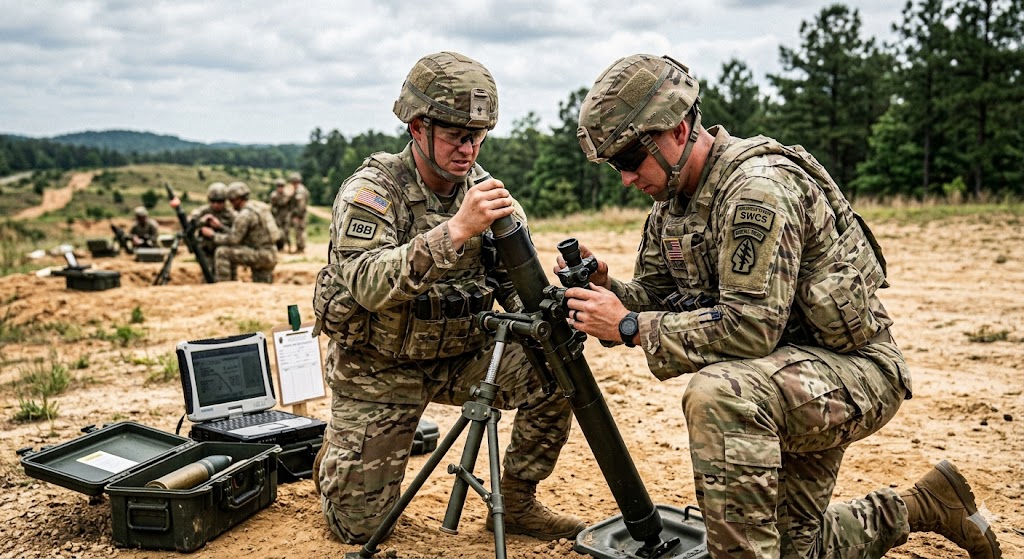
The core of the assessment focuses on the M252/M252A1 81mm medium mortar
system. Students must demonstrate complete mastery over the weapon’s
characteristics, nomenclature, capabilities, limitations, and stringent safety
regulations. A significant portion of the course and exam is dedicated to Fire
Direction Procedures. This includes both analog computations utilizing the M16
Plotting Board and digital operations using modern ballistic computers like the
Lightweight Handheld Mortar Ballistic Computer (LHMBC) and the Mortar Fire
Control System (MFCS). Soldiers are tested on Observed Fire (OF) procedures,
calling for and adjusting fires, and solving complex tactical employment
problems. You must prove you can emplace, aim, compute, fire, adjust, and
displace the mortar element faster and more accurately than the enemy, often
under extreme pressure.
What to Expect in the Final Exam
You should expect a rigorous, two-phased evaluation
process structured to test both theoretical knowledge and practical
application. The first phase is a comprehensive written examination consisting
of multiple-choice and complex short-answer calculation questions. This written
portion focuses heavily on nomenclature, ammunition identification, range
tables, safety data, and the intricate mathematical formulas required for Fire
Direction Center calculations. The passing score for the written component is
typically very high (often 80% or better), and failure on critical
safety-related questions is unacceptable. The second phase is the crucial
Practical Gunner's Examination and Field Evaluation. You will be graded on your
speed and precision while emplacing the 81mm mortar system, performing
reciprocal lay, responding to fire missions, and diagnosing/correcting
malfunctions. Furthermore, the evaluation will include a live-fire or simulated
tactical scenario where you must act as the leader of the mortar element,
planning and executing fires based on a rapidly changing combat situation.
Perfect execution of all mechanical drills and safety checks is required during
the practical phase.
How to Study and Exam Centers
Preparation for this rigorous examination must be
multi-faceted and relentless. First and foremost, you must dedicate yourself to
studying the primary doctrinal publications. Master Training Circular TC
3-22.90 (Mortars) until you know it backward. Use current training materials
from the Maneuver Center of Excellence (MCoE). Create detailed flashcards for
all system nomenclature, weight specifications, minimum and maximum ranges for
different ammunition types, and, most importantly, the exact procedures for
every mechanical drill. Practice solving analog Fire Direction problems on the
M16 Plotting Board repeatedly until the process is automatic; speed and
accuracy only come from high-repetition practice. If access is available, get
hands-on time with the M252 system every single day to maximize your speed and
physical memory for the practical gunner's exam. Regarding the test itself,
this is an internal US Army evaluation. It is strictly administered within
specific military training centers, most notably the Special Warfare Center and
School (SWCS) at Fort Liberty, North Carolina, or the Maneuver Center of
Excellence at Fort Moore (formerly Benning), Georgia. Authorized unit-level
master gunners or senior instructors may also administer qualification tests
under rigorous oversight, but there are no external, commercial testing centers
for this military skill.
Job Opportunities from the Course
Mastery of 18B Mortar Employment and the 81mm system
unlocks specific, critical career paths and roles that demand the highest level
of indirect fire expertise. Below is a list of job titles and responsibilities
directly enabled by this level of proficiency.
<!--[if !supportLists]-->·
<!--[endif]-->Special Forces Weapons Sergeant (18B): Leading a
mortar element or supervising indirect fires for a 12-man Special Forces
Operational Detachment Alpha (ODA).
<!--[if !supportLists]-->·
<!--[endif]-->Special Forces Intelligence Sergeant (18F): Utilizing
advanced fire support knowledge to integrate mortars into strategic planning
and targeting during operational deployments.
<!--[if !supportLists]-->·
<!--[endif]-->Special Forces Operations Sergeant (18Z): Planning
company or battalion-level Special Operations involving organic indirect fire
support assets.
<!--[if !supportLists]-->·
<!--[endif]-->Infantry Mortar Platoon Sergeant (MOS 11C): Supervising
multiple 81mm or 120mm mortar sections within a standard Infantry Company or
Battalion.
<!--[if !supportLists]-->·
<!--[endif]-->Mortar Master Gunner (MCoE/SWCS): Acting as the
primary subject matter expert and instructor at major military training
institutions, developing new mortar doctrine and testing future systems.
<!--[if !supportLists]-->·
<!--[endif]-->Mortar Instructor: Training the next generation of 11C
and 18B Soldiers at institutional schools like SWCS or Fort Moore.
<!--[if !supportLists]-->·
<!--[endif]-->Joint Terminal Attack Controller (JTAC) or Joint Fire
Support Specialist (13F): Personnel in these fire support roles benefit
immensely from 18B-level mortar knowledge when coordinating artillery and
aviation fires in conjunction with organic organic mortars.
Frequently Asked Questions
Reviews
5.0
Based on 0 reviews
Leave a Review
No reviews yet. Be the first to review!
Looking for More?
Check out our comprehensive package plans for ultimate prep materials and exams!
View All Packages